

Last year, the US vice president, JD Vance, caused uproar with a speech lambasting other leaders for ‘the retreat of Europe from some of its most fundamental values’ and urging them to ‘the blessings of liberty’. He accused them of ‘dismissing people, dismissing their concerns… shutting people out of the political process’. The message was clear, beyond the usual scolding about European defence budgets: Europe had lost its way and America wasn’t going to stand for it anymore.
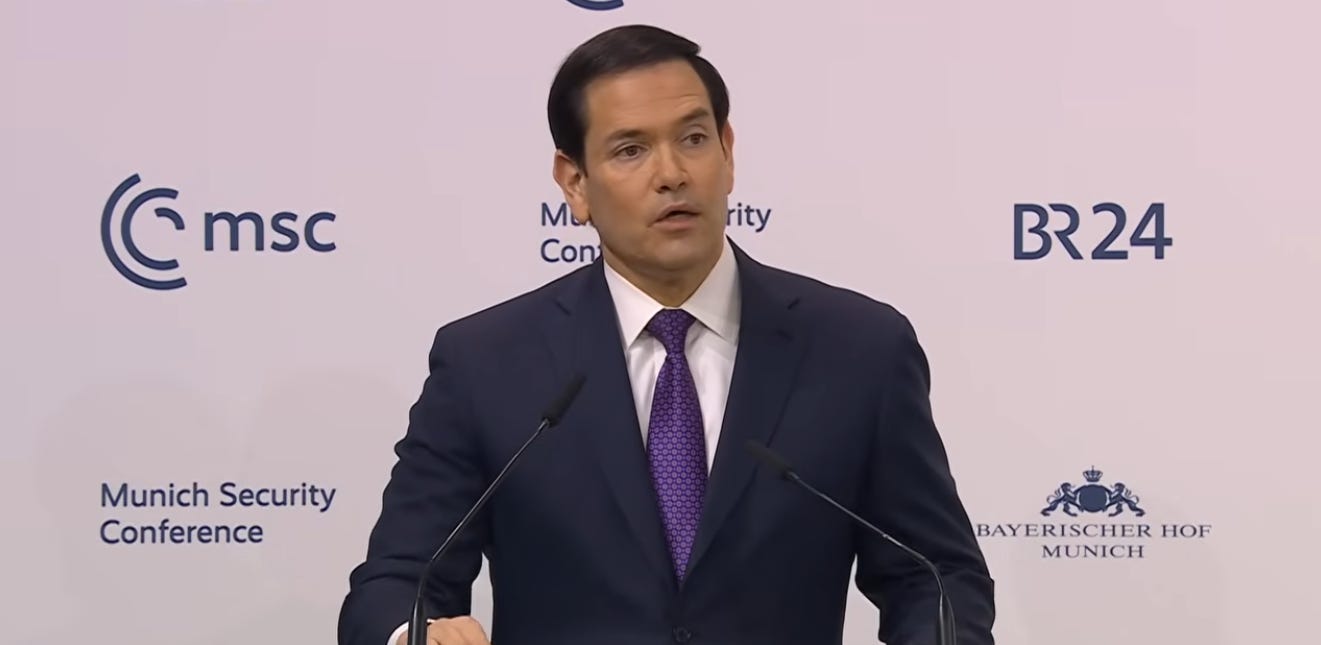
This year, the tone was somewhat different. This time it was the US secretary of state, Marco Rubio, delivering the much-anticipated speech. While the tone was more emollient, the message was familiar.
So while common ground was initially emphasised – NATO’s victory against the authoritarianism of the Soviet Union – Rubio argued that ‘the euphoria of this triumph led us to a dangerous delusion: that we had entered, quote, “the end of history”; that every nation would now be a liberal democracy; that the ties formed by trade and by commerce alone would now replace nationhood; that the rules-based global order – an overused term – would now replace the national interest; and that we would now live in a world without borders where everyone became a citizen of the world.’
Echoing Vance, Rubio declared: ‘We are part of one civilization – Western civilization. We are bound to one another by the deepest bonds that nations could share, forged by centuries of shared history, Christian faith, culture, heritage, language, ancestry, and the sacrifices our forefathers made together for the common civilization to which we have fallen heir.’
Rubio rightly noted: ‘National security, which this conference is largely about, is not merely a series of technical questions – how much we spend on defence or where, how we deploy it, these are important questions. They are. But they are not the fundamental one. The fundamental question we must answer at the outset is what exactly are we defending, because armies do not fight for abstractions. Armies fight for a people; armies fight for a nation. Armies fight for a way of life. And that is what we are defending: a great civilization that has every reason to be proud of its history, confident of its future, and aims to always be the master of its own economic and political destiny.’
Rubio’s speech was awaited with trepidation after the furore over Greenland just weeks before. In the event, it was more diplomatic than many had expected. But the upshot was clear: America doesn’t really trust Europe anymore and Europe will have to step up in terms of defence and the way it is ruled for that to change.
There are some signs that Europe is prepared to spend more on its own defence. Germany is planning to double its defence budget, a sea change from the postwar era. But France and Italy are already knee-deep in debt and the UK isn’t much better off. The ruling elites in Europe are, as Rubio noted, utterly wedded to an authoritarian, ‘progressive’ worldview. Thanks in part to its embrace of environmentalism over economic growth, Europe’s deindustrialisation is gathering pace and its economies are moribund. Never mind soldiers, ships and planes – Europe’s entire social fabric is unprepared for a war, even if one with Russia still seems unlikely.
Where does this leave relations between Europe and America today? Is Trump merely bringing out into the open longstanding tensions? Is this a sign of American weakness rather than strength? With Trump’s biggest concern being the rise of China, how does this fit into the wider state of geopolitics today?
We’ll be discussing these issues at the next Academy of Ideas Economy Forum, After Greenland: understanding the new geopolitics, next Tuesday evening, 7pm via Zoom. It will be a great opportunity to bring some clarity to these issues. The discussion will be introduced by Phil Mullan and James Woudhuysen. You can find full details and selected readings below. I hope to see you there.

After Greenland: understanding the new geopolitics
Tuesday 24 February at 7:00 pm - 8:30 pm
This event is free of charge but please register via Eventbrite.
INTRODUCTION
President Trump’s insistence that the US must take control of Greenland has caused a furore, particularly among America’s NATO allies. Many are scratching their heads about why Trump went in so hard – including threatening new tariffs and even military action against America’s supposed friends on the world stage. After all, the US already has the power to station troops and weapons systems in Greenland thanks to a decades-old treaty.
Just weeks after the capture of Venezuelan president Nicolás Maduro, the Greenland controversy was widely seen as the assertion of a ‘Don-roe doctrine’, with America asserting itself in its own ‘backyard’. One thing for sure is that the notion of a ‘rules-based international order’ – more convention than reality – has not been called into question as much in decades.
Trump’s over-riding concern seems to be China as an international rival. The Chinese government continues to demand control over Taiwan and has been marking out a zone of influence in the South China Sea and elsewhere. Meanwhile, Russia’s invasion of Ukraine was viewed by many as the return of Great Power politics. Signs that Trump is more interested in settling the conflict than in supporting Ukrainian sovereignty only strengthen that belief.
How can we understand these new developments? Is this a sign of American strength or weakness? Is the world going to be divided into rival regional power blocs? With Europe now unable to assert itself, will it be marginalised now? Is there any chance of a new, stable international settlement?
SPEAKERS
Phil Mullan
writer, lecturer and business manager; author, Beyond Confrontation: globalists, nationalists and their discontents
James Woudhuysen
visiting professor, forecasting and innovation, London South Bank University
SELECTED READING
The West needs a reckoning with America’s decline
Phil Mullan, spiked, 24 January 2026
Why Trump wants Greenland
James Woudhuysen, spiked, 20 January 2026
The ‘Old World Order’ is over, but a new one is not inevitable
Phil Mullan, Academy of Ideas Substack, 22 January 2026
Labour will leave Britain defenceless
James Woudhuysen, spiked, 4 June 2025
The death of the West?
Phil Mullan, spiked, 11 March 2025