

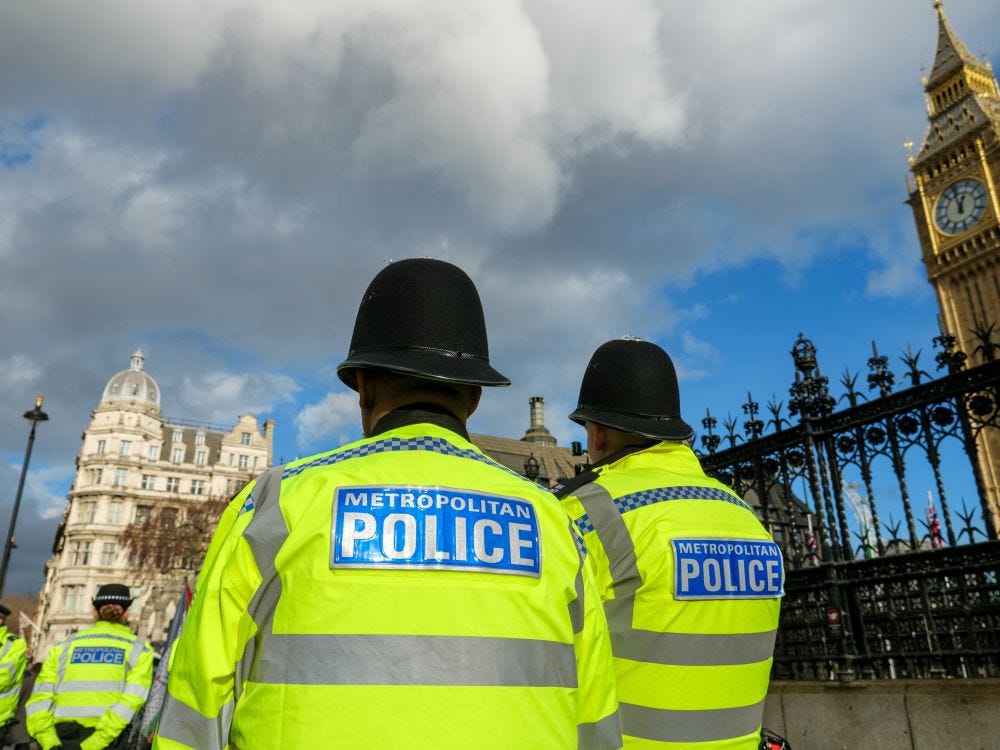
Reading this account from the BBC of how a sexual predator, Simon Levy – who police knew about, but somehow managed to evade detention – was so gruelling and also enraging. It is infuriating and scary that on numerous occasions the criminal-justice system and the police had him in their grasp. However, something between wilful incompetence and indifference from our hollowed-out state institutions – in this instance, the police – enabled Levy to operate with impunity. This meant the rapes and murders he has now, at last, been jailed for were likely to have been preventable.
Meanwhile, almost at the same time, a journalist who emailed questions about his academic record to Jason Arday, the Cambridge professor accused of plagiarism and Walter Mitty levels of fantastical fabrication, was investigated by the Met for four months. The journalist, Jack Grove, was not even interviewed and only learned of the investigation when the Met got in touch to inform him that the case had been closed. This Orwellian twist was only beaten by the newspeak used by the Met Commissioner Sir Mark Rowley about the case. Rowley told Nick Ferrari on LBC: ‘We dropped the ball on that one – let’s not beat around the bush. It should have been screened out as not requiring police action.’ Dropped the ball? The temerity!
All this reminded me of a speech I gave in June. It is titled ‘Hate, harms and freedoms: the dilemmas of discretion and the limits of policing’ and was delivered at the Police Foundation / Cumberland Lodge Police Conference 2026 – which had the theme of ‘Division, Distrust and Disorder: Policing Polarisation in Modern Society’. I decided to type up my lecture, as the themes feel relevant. This seeming crisis in policing will inform several debates at this year’s Battle of Ideas festival, which now feel more urgent than ever. BUY TICKETS HERE.
And it means I am especially looking forward to digging deep into such issues at the Ideas Matter annual residential weekend, The Academy. This year’s theme is Hollow Leviathan: the state against the demos. There are still day and weekend tickets available HERE. Hopefully see you there.
In the meantime, here’s my speech. Read it imagining the faces of the many police officers of all ranks listening in the audience…
Claire
Hate, harms and freedoms: the dilemmas of discretion and the limits of policing
A young colleague of mine recently took a police force in the North East to court. Linzi Smith is a lesbian who believes that replacing binary sex with gender identity undermines women’s rights and same sex attraction. She challenged the decision of Northumbria Police’s chief constable, Vanessa Jardine, authorising officers to participate in the Newcastle Pride demo in 2024. This included officers displaying Pride and Progress flags, rainbow lanyards and a police car carrying these symbols.
Linzi argued this amounted to political expression, inconsistent with the police duty of impartiality. The judge was scathing in criticising the police. Linzi won. But surely it shouldn’t have taken a court case to state the bleedin’ obvious. The police should police demonstrations, not send contingents on them. They should not be activists in uniform, take the knee, show political bias.
However, I have no doubt this was all well-intentioned – to show the LGBTQ+ community that the police were on their side against supposed transphobic hate. I fear such good intentions are fuelling the public perceptions about the police as unfair, taking sides, policing WITH fear and favour – and all this contributes to the ‘two-tier policing’ narrative.
I’m sure good intentions lurked somewhere in the Henry Nowak story to explain why police officers fell for a murderer’s lies when the now convicted perpetrator Vikram Digwa played the race card, as a victim of hate. Yet it perfectly encapsulates my concerns – that policing has become mired in identity politics. Tackling hate has become an unquestioned orthodoxy, with no room for discretion or common sense.
CULTURE OF CONFORMITY
Perhaps one reason why those officers who handcuffed Henry as he was dying were so easily misled by the false accusations of racism, is a culture of conformity – even fear – in the force: that individual officers dare not voice any opposition to prioritising hate crime over all else. Indeed, anecdotally, I keep hearing from rank-and-file officers – off the record – that those who query the hate agenda are told they are in need of re-education or know they will forfeit promotion or be driven out if they raise any objections. They are effectively told to put up or shut up.
In parliament, I raised the example of Rick Prior who, when head of the Met’s Police Federation, told a TV interview about a crisis of confidence within the ranks of policing, with officers withdrawing from any kind of pro-active front-line policing of ethnic-minority citizens for fear of falling foul of vexatious complaints about racism. You may agree or even vehemently disagree. But did it merit being suspended and locked out of his email / IT system, which led to Rick taking his case to a tribunal? He won.
Meanwhile, only last week, Luke Salmons won his appeal after being sacked as a police community support officer. The issue was a conversation about the war in Gaza with a Muslim officer at a training day on race, religion and culture. To note – the Muslim officer was not offended and did not complain, but the exchange was reported as Islamophobic hate by a senior officer.
DEFINING HATE AND HARM
If such a muddle can lead to mistaken accusations internally, imagine policing the public for hate offences. No wonder enforcement is inconsistent. One reason for this is the broad and elastic definition of hate. Lord Sumption articulately summed up the problems with all the hate-related legislation cluttering up the justice system. It’s worth quoting in full:
The Crown Prosecution Service and the Police have agreed to define a hate crime as anything which is perceived by the victim or anyone else, to be motivate by hostility or prejudice. In other words, the definition which they use is subjective… If the complainant thinks it’s a hate crime, then it is a hate crime.
Let me repeat that: If the complainant thinks it’s a hate crime, then it is a hate crime. There’s not much room for discretion there.
Sumption goes on:
One would think that hatred implied a very high degree of animosity, but the CPS has suggested it can include ill-will, spite, contempt, prejudice, unfriendliness, antagonism, resentment and dislike.
Goodness, no wonder the police can get this so wrong. And no wonder HATE – as so loosely defined in criminal justice – can be a green light for both censorship and excessive interventions in interpersonal relations. The vague lack of precision in terminology, with a low threshold for intervention, can empower self-defined victims to use the law as a heckler’s veto to trigger police action against legal speech, based on hurt feelings and emotional upset.
What constitutes harm-related hate speech is equally amorphous and confusing, with a dangerous conflation between speech and action. Let me give you an example from outside of policing. A few years ago, I was invited to speak on the importance of debate to a university debating society. A few days beforehand, I was disinvited, after a no-platform campaign by the student union – my cancellation backed up by the university authorities.
I was genuinely shocked when told my presence on campus was a safeguarding risk that would cause harm to students. It made it sound as though I planned to turn up with a baseball bat or had threatened to punch a bunch of undergrads. But my ‘crime’ was… I liked a tweet by Ricky Gervais. This got me labelled as a transphobic hatemonger, so my words on debate were deemed too dangerous, on a par with a physical threat, to be heard. So, no debate.
This might seem a daft student-politics example, but politicians ape this approach to words and harm. Government ministers regularly launch into hectoring lectures to politicians about harmful rhetoric and the public are endlessly told to watch their language and tweets. It’s aggressively declared that a phrase like ‘pure cold rage’ (used by Nigel Farage in relation to the murder of Henry Nowak) is whipping up hate, as though the real threat to society is expressing unsanctioned fury, rather than what that fury is in response to. Well, I’ve got a confession – perhaps unwise in a room full of coppers – but I have felt and expressed pure hot rage, and worse, over many things in recent years, like the rape grooming gangs, the preventable massacre of those three little girls in Southport, over the medieval, barbaric attack in Belfast, and the contents of that bodycam footage revealing the truth of how Henry Nowak died. And suppressing our freedom to say out loud that we feel understandable rage, even hate, when such terrible events happen, only creates the pressure cooker atmosphere that then can explode on our streets as civil unrest. That’s the real harm.
All this muddle over what constitutes hate and harm is what undoubtedly fed the hyper-activity associated with the College of Policing’s now discredited ‘non-crime hate incidents’ (NCHIs). These were used so promiscuously that even The Economist – hardly a far-right peddler of misinformation – wrote about NCHIs as an egregious example of state over-reach that did huge damage to the credibility of the police, who were disproportionately spending so much time punishing wrong-think and thought crimes online, they forgot about catching criminals offline. The popular slogan, ‘Police our streets not our tweets’, is apt.
Even now, when NCHIs have been abolished formally – in name, at least – senior police officers have been keen to reassure us they’ll still continue to focus on safeguarding the most vulnerable from abuse motivated by hate based on race, religion, disability, sexual orientation, sex or transgender identity. Those identity groups are assured ‘you should feel confident in reporting hate and know it will be taken seriously’.
POLICE: NEW IDENTITARIANS?
But seeing policing through the prism of identity groups is inevitably divisive and has dragged the police into some of the most toxic ideological disputes in society. For example, I checked out the police’s True Vision website, a hate-crime portal set up in 2018 to encourage the public to report hate online. Just to use one example to illustrate the political and operational mire this has led policing into. I found the definition of ‘transgender hate crime’ especially worrying.
It’s said that such a hate crime should be reported about anyone who a victim perceives has been targeted because of the ‘offender’s hostility to a transgender person or to transgender people in general’. In general? What a hostage to fortune. It could and does capture many of us who are hostile to gender ideology or refuse to be compelled to call a man who identifies as a woman, she etc.
The definition also states: ‘A transgender hate crime could target someone who is not themselves transgender and the harmed person could be for example, a child of a transgender person or someone mistaken for being transgender, so long as the offender is motivated wholly or partially by hostility to transgender people.’ Quite apart from describing someone merely accused as an ‘offender’, what on earth does partially motivated mean? There’s a hell of a lot of leeway for over-interpretation here.
But if any members of the public are unsure, True Vision invites – even incites – them to report regardless, even deploying a degree of more pressure to do so: ‘By reporting it, you may be able to prevent these incidents from happening to someone else. Reporting makes a difference… to you, your friends, your community and your life.’ No wonder there’s an explosion of hate crime statistics, especially when the police also have performance targets and internal measure to reach, to counter alleged under-reporting.
The danger here is that if hate crime is so easy to report, with such a presumption of belief in the victims’ allegations (and note True Vision use the term ‘offender’ throughout – so much for innocent until proven guilty) then hate crime can become a preferred vehicle for nefarious personal and political vendettas. Activists can use the police as useful idiots to brand opponents as bigots.
That at least partly explains the ludicrous and infamous arrest of comedy writer Graham Linehan by five armed police at Heathrow airport for posting a crude joke on X. He was reported by a notorious trans activist and serial complainant, who by the way happened to be an ex-police officer. And yes, all charges were dropped and Linehan received a grovelling apology, but it took a five-month internal investigation to say it was a mistake. What a waste of time and resources when it was obvious to everyone it was an over-reaction.
IDEOLOGICAL CLAPTRAP?
One explanation for the police being so over-zealous on hate in this way is the impact of the legal duty on public bodies to drive quality and diversity internally. Kemi Badenoch has rightly highlighted how this Public Sector Equality Duty as part of the 2010 Equality Act legally obliges forces to roll out police action plans and EDI training, etc. And has been widely reported, that training has been politicised. Officers are schooled in the language of unconscious bias, microaggressions, indirect hate and so on. The whole academic discourse associated with critical theory litters training modules, such as ‘intersectional victim hierarchies’ (with white people at the top). Cut-and-paste mantras are internalised, with little room for discretion, critical engagement or pushback.
This isn’t useful, practical, professional training in, for example, how to deal with someone who claims to be stabbed. If only. Hampshire’s almost £1million spend on compulsory race training promises to ‘educate the workforce on the importance of being an ally’. But an ally to who? Certainly not Henry Nowak.
Now you all seem like down-to-earth, sensible people – so why do you buy in to this ideological claptrap? One tentative explanation: the police service – as a state institution – seems to have no confidence in itself being fair. It did more than learn the lessons from the Stephen Lawrence murder over 30 years ago; it seems to have developed a guilt-ridden bending of the stick to prove it’s not institutionally racist or bigoted, and so laps up every identitarian fashionable fad on offer, so such so, that whatever its formal obligations, it’s even suspicious of impartiality.
This lack of confidence also means the service is always looking out for allies outside the force to get the line right. So, it turns to third-party advisers, (often from activist NGOs), representatives of myriad identity groups and so-called community leaders. But at what cost? The West Midlands Police force disgraced themselves by using falsehoods about Maccabi Tel Aviv football fans, having been advised by local Muslim leaders, many with Islamist sympathies, and effectively ended up banning a Jewish team and its supporters from Birmingham.
And to finish, there’s the story of Elaine (a pseudonym), the chair of Bradford’s independent policing hate-crime panel. She told the Telegraph’s Allison Pearson that she was sacked by West Yorkshire police because she said, in a meeting after the murderous Manchester Synagogue attack, that attendees were avoiding the elephant in the room: Islamist extremism aimed at Jews. Instead, the meeting focused on demands to know what the police were going to do to protect Muslims and mosques from hate speech. Elaine’s intervention allegedly led to outrage from community leaders and, indeed, Muslim officers. Cue a seemingly orchestrated pile-on of mass malicious complaints that led to this retired academic in her 60s being labelled ‘A Tommy Robinson Tribute Act’ and accused of ‘outright hate and racism’.
Her dismissal letter from a senior officer described her remarks as ‘divisive and inflammatory’, and even said consideration was given as to whether this hate-crime adviser had herself committed a hate crime. This surely illustrates where the police’s obsession with seeing hate everywhere leads – to eating its own. How else to describe being more anxious to protect the sensitivities of the Muslim community leaders shouting hate than the actual physical threat of antisemitic violence or defending a public servant just trying to do her job by speaking frankly. It’s a sorry tale. But it should act as a cautionary one, and a warning about how the focus on hate is corrupting police priorities and betraying forces’ duty to be impartial.
The Police Forces (as they once were) were trusted and respected by the majority because they were no one's ally's. Their duty was to uphold and enforce the law without fear or favour. From the richest to the poorest, regardless of race, creed or colour the law was mostly seen to be applied equally. Today the Police Services are seen to uphold the law selectively, to apply it selectively and are ally's to some and the dispelers of instant injustice (Henry Novak) to others. They have lost our trust and they have lost our respect.
It's terrible! How can we explain that our own elected officials are responsible for this impact on Western civilization?