

Suella Braverman MP, the former Conservative home secretary who recently defected Reform UK, has just been unveiled as the party’s education and skills ‘shadow secretary’, declaring: ‘A Reform government will restore freedom to our schools.’ She certainly has her work cut out, as the Labour government’s recent interventions are fundamentally changing how schooling is organised. And freedom is not top of its agenda.
According to Julie Bindel, in a stinging rebuke of the government’s education policies, Bridgette Phillipson is ‘not only the worst, but the most dangerous education secretary in living memory’. Regardless, at a time when school pupils of 16 are about to be given the vote, we all have an interest in keeping our eye on what Ms Phillipson and her department are up to – and to ensuring a lively public debate on education more broadly and, specifically, how schools should be organised.
This is pertinent because the Children’s Wellbeing and Schools Bill is now trundling towards gaining royal assent and becoming law. Beyond the prescriptive and intrusive registers and surveillance of home-schooling parents and their children, and the much-vaunted and overblown mandate that state primaries offer free breakfast clubs, the legislation creates a huge, new regulatory regime that will rein in academy schools’ autonomy from local education authorities.
Whatever your view on academies, and I am personally not an uncritical cheerleader, until Keir Starmer’s reign they were viewed as relatively successful by all parties. But the law change means that schools will now be denied the freedom to make decisions on curriculum, staffing and timetabling and instead have to follow dogmatic national guidelines, with far-reaching impacts on what children learn and how teachers teach.
And, of course, this is on the back of the Labour government’s imposition of VAT on private-school fees, justified as a policy to end the ‘luxury’ of private school ‘tax exemptions’, but characterised by critics as a tax-raid driven by class spite. Regardless, many private schools are now closing as a consequence and aspiring working-class parents and those of children with special needs (that the state sector can’t cope with), have become the loudest critics of the policy. Inevitably, these children are now struggling to find spaces in state schools. What a mess.
In this context, this essay by educationalist and writer Joe Nutt is a valuable provocation into the debate, to help Suella - and the rest of us - work out what schools policy should look like.
After Joe’s essay, you can also listen to the audio of our debate Tax on private schools: social justice or spite? from last year’s Battle of Ideas festival.
Why politics never produces great schools
Joe Nutt
What if, instead of being conned by the OECD into thinking you can compare the quality of a nation’s schools by juggling data from PISA tests that the teenagers who take them have absolutely zero incentive in, British politicians simply admitted what the rest of the world actually knows?
It’s undeniable that Great Britain leads the world when it comes to high-quality schooling. We are the only nation with dozens of schools so admired and highly prized by parents internationally that we can export them almost at will. We even have some genuinely great state schools. So, it hasn’t escaped anyone’s notice that the current minister for breakfasts isn’t interested in visiting, or learning, from any of them.
If you follow educational news, you will have seen regular calls for Katherine Birbalsingh, headmistress of the most well-known successful state school, Michaela Free School in Wembley, to at least be consulted by politicians, if not somehow magically reincarnated as minister for education. People outside the sector understandably have a naïve idea that if you can run a successful school in one place, you can run lots of them elsewhere. This is, I’m sorry to have to say, untrue, because all great schools are unique.
The best Katherine could ever do is what she has done from the start: encourage anyone to visit and learn for themselves. This is an invitation numerous education ministers in other nations have wisely accepted. Clearly, they know there is more to the job than spite and Cheerios.
However, the question anyone serious about this should be asking, is an entirely different one. How do we create the conditions necessary for the establishment and growth of many more genuinely great schools?
The Tories had a reasonable idea when they created the concept of the free school. Michaela is proof of that, but ironically the seeds of the concept’s failure were sown at birth precisely because the concept originated with politicians. The free school initiative should have created far more schools as effective and successful as Michaela. So why didn’t it?
To answer this, you need to have a lucid grasp of what really happens when government wants to do something new in education, and decides to spend your money to do it. That word really is crucial. Politicians will make all kinds of claims about what they intend, but very few of them have ever run successful businesses or delivered anything of value to anyone, never mind something as sophisticated and complex as a great school. What I’m interested in explaining here is the literal reality that stems from politicians having steadily accrued to themselves, over decades, absurd levels of control and influence over the nation’s schooling.
The first step is usually to establish a quango, a body we all pay for with our taxes, but which is purportedly outside the political arena. To quote Hollywood’s favourite hooker, from Pretty Woman: ‘Big, big mistake...huge!’ So, Blair’s Labour government created Becta (British Educational Communications and Technology Agency) in 1998, to push technology in schools. Similarly, the coalition government backed the New Schools Network (NSN) in 2010 to drive the free-schools initiative. Becta’s annual budget was around £65million and it was responsible for running other programmes to the tune of around £900million, while the NSN’s budget at its peak was around £3million.
Sometimes, governments will run programmes directly from the Department for Education, with their own timescale and goals. The latter was the case with the Conservatives’ unusually persistent focus on literacy, under the schools minister, Nick Gibb, over about a decade, costing roughly £100million. The Labour party’s initiative for improving schools in the nation’s capital, the London Challenge, ran for eight years and cost in the region of £80million. Just to add flavour, the Labour party’s £62million attempt to create a national e-university collapsed in half that time when it had recruited a total of only 900 students. The goal was... 5,600.
Both these strategies come with the same fatal weakness. Those immense sums of your money have to be spent, and almost all of it goes on only two things: people and technology. Oddly, given the joke about expecting nothing but negativity from a computer, it is the human side of the process that is the greatest barrier to success. In any well-run commercial business, pretty much everyone’s role is clearly described and their performance effectively monitored in terms of delivering against individual and company goals. These programmes and quangos pay lip service at best to this kind of effective performance management, for one profoundly foot-blasting reason: the individuals employed are always recruited primarily for one characteristic, and one only – their political alignment.
On rare occasions, someone might find themselves moved from an existing post into a new role in one of these quangos or programmes, but you can almost guarantee that if their party politics doesn’t match with the political leadership of the time, they will vanish. The real world dynamic at work in these organisations isn’t profitability, customer service or even just organisational success – it’s one of personal political advancement.
In effect, your job in such an organisation is to secure personal advancement through political patronage. It is so obvious to anyone who has worked extensively at higher levels in the education sector that even the tiny handful of bodies and organisations in there which are genuinely independent, and do not rely on government funding, tend to be led by people driven by the same, entirely political incentives.
The interplay between all bodies and organisations actively involved in schooling is entirely and completely dominated by political interests, for the simple reason that government spends bewildering amounts of taxpayers’ money on it.
You may be ideally qualified for a role in terms of your professional and commercial experience in the sector, but you will stand no chance of being employed in any of these programmes or quangos because, first of all, that experience will almost certainly make you too expensive and, secondly, you will not pass the Masonic, party-purity test. So, the tax-paying public get the worst of both worlds for their money: people who are not up to the job and people focused only on their personal advancement, in a world not measured by results, but by handshakes.
Just one illustration from many I could cite. The London Challenge, like the e-university, had distinct targets. Success was to be measured by only three reasonably specific ones:
to reduce the number of underperforming schools, especially in relation to English and maths
to increase the number of schools rated as ‘good’ or ‘outstanding’ by Ofsted
to improve educational outcomes for disadvantaged children
A few years ago, I watched two academic researchers present their statistical analyses of the London Challenge. Both were good speakers and presented information clearly using graphics and sensible text. One concluded the challenge had been reasonably effective; the other argued that it had made no discernible difference at all and any improvements in exam results could be accounted for by demographic factors.
A third presentation was given by the ex-civil servant who had led the Challenge. He, too, used a combination of different statistics, graphically presented, and simple text to support his view that the Challenge was a roaring success. As Mandy Rice Davies might have commented: ‘Well, he would, wouldn’t he?’
At the time, I actually knew what those three targets of the London Challenge were.
I asked the ex-civil servant the obvious question. ‘These were your three objectives. Can you tell us if you met any of them?’ He couldn’t and claimed that they had changed the objectives. What those were, he wouldn’t say. Most significantly for my argument here, he had already progressed to become CEO of one of the largest academy trusts in the country. He had no educational experience whatsoever.
In case you think that’s an oddity, I could name two individuals my work brought me into contact with in these types of organisations who had absolutely no relevant professional educational experience. When their organisations were wound up, they moved into the House of Lords... in their thirties. That is what success really looks like in the world of education, when we allow politicians to run it.
To readdress that increasingly urgent question, because every day that Bridget Phillipson remains in post that urgency accelerates: How do we create the conditions necessary for the establishment and growth of many more genuinely great schools? The first step to genuine reform must be to sever the link between politicians and schooling. Their role, if they are to have any at all in the future, needs to be nothing more significant that budgetary oversight; the same kind of healthy, distanced responsibility school governors are used to maintaining, without interfering with the genuine professionals who know how to run a school.
Two other huge reforms need to happen parallel to that. Ofsted – which has always been about as sophisticated as a nutty sledgehammer, but is now nothing more than a Sword of Damocles over school principals – has to go. And so do the teacher unions. More precisely, the unions’ stranglehold on pay bargaining has to end. The most disgusting, anti-professional trick the unions and politicians play on teachers is convincing them there is no market for their skills. This is nonsense. In the real world, teaching has one of the most astoundingly wide spectrums of possible remuneration, of any profession. If you’re a genuine polymath, I could find you work at around $200,000 a year.
If teachers still want to pay regular fees for some kind of insurance cover, or are even gullible enough to subsidise the political ambitions of union reps and leaders, let them. But the appalling deceit that teaching is a profession operating outside a vibrant international market has to end.
However, before any of that can happen there is one other major reform that cannot happen soon enough. The country needs to say, ‘Cheerio’ to the minister for Cheerios, not least because the price you and I are all paying for free breakfasts is one Great Britain really cannot afford.
Joe Nutt is the author of several books about the poetry of Donne, Milton and Shakespeare and a collection of essays, The Point of Poetry.
Tax on private schools: social justice or spite?
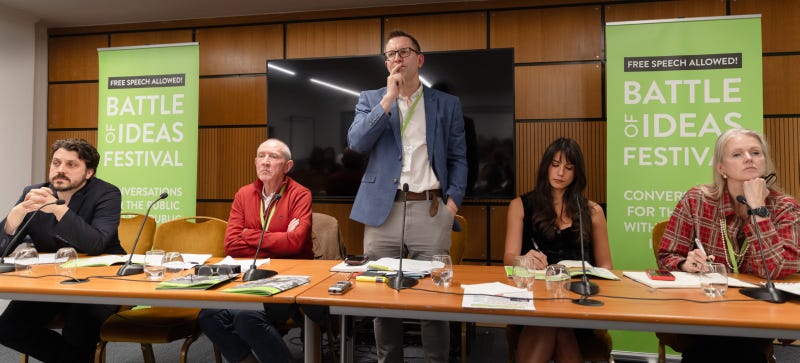
Joe Nutt was one of the speakers at this debate at the Battle of Ideas festival 2025, along with Baroness Joanne Cash, Stella Tsantekidou and Charlie Winstanley. Click on the player below to listen.