

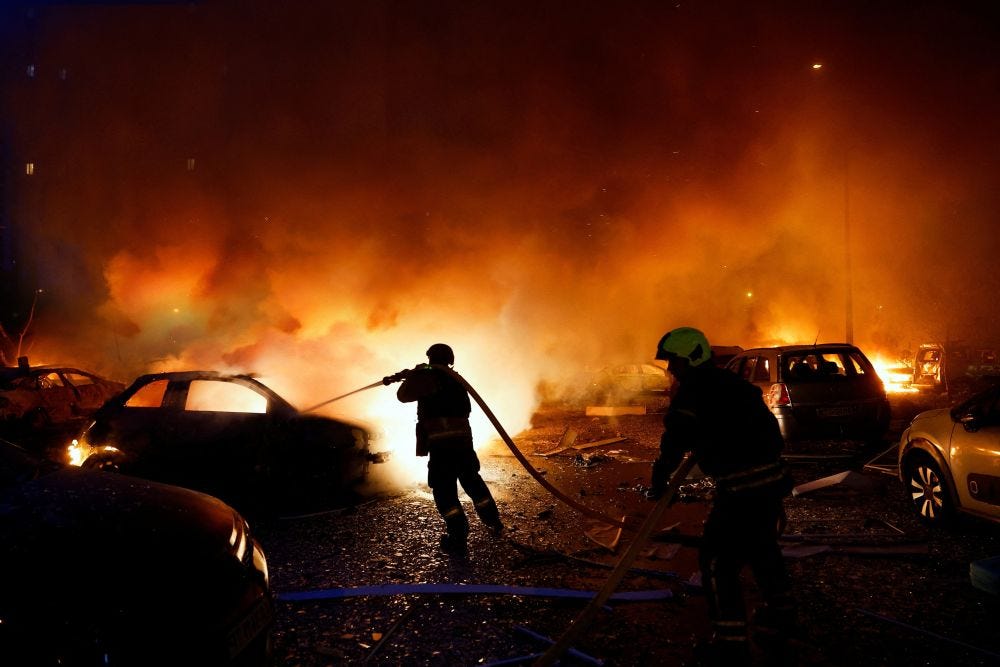
Wildfires continue to rage across Europe, even if the worst may have passed – for now. France has been hit relatively hard, with the burned area for the year to date already (between 91,000 and 116,000 hectares) easily surpassing the previous full-year record (66,337 hectares) set in 2022. Spain, too, seems to be having a record-breaking year, with 200,000 hectares burned. Portugal, Italy, Greece and others are also having unusually bad seasons. In the UK, there have been major fires from the Cairngorms in Scotland to Dunwich in Suffolk.
Naturally, the blame has been put on man-made climate change. Persistently high temperatures have dried out the landscapes across Europe, turning them into a tinderbox. Looking at the forecast for today, London faces yet another day well above 30 degrees Celsius. Yes, it’s summer and you expect it to be hot. On the other hand, London has apparently had more days above 30 degrees this year (25 and counting) than in the whole of the Eighties (21 days in total).
It’s hot, it’s dry, it’s uncomfortable to live with when you’re not used to it. What was once extreme weather seems to be becoming the norm. But what is to be done?
One side of this debate is crystal clear: fossil fuels are the root cause, so we need to accelerate the decarbonisation of the economy. In a much-discussed article for the Telegraph last week, Tim Stanley argued that tackling climate change should not be an issue left to left-leaning eco-warriors. It’s time, he said, for the political right to get serious about the problem, too, rather than reject the Net Zero policies that were, after all, introduced by a Conservative government.
The transformation of a tangible ecological crisis into a culture-war abstraction can be pinned on the Left. They framed it as a divine chastisement; they wallowed in its penance, imposing arbitrary deadlines and contrary measures that, in an act of pure self-flagellation, took nuclear off the table.
But the Right reacted with misplaced sympathy for the devil, telling itself that fossil-fuel giants are the good guys, renewables a joke, and decarbonisation rooted in a misreading of human nature.
The article created a heated debate (pun intended). In response, also in the pages of the Telegraph, David Frost pushed back. Whether you think temperature rises in the future will be mild or catastrophic, we need to think to think seriously about the costs and benefits of decarbonising the UK economy. Offering ‘global leadership’ on climate means nothing if the rest of the world is following a different path. It simply means impoverishing ourselves for nothing.
In China, one-sixth of the global economy on its own, carbon emissions have gone up by more than 250 per cent since 2000. China’s energy consumption is around four times as much as in 2000 and electricity consumption has gone up even faster. Both are powered by coal, which China is using at its highest-ever levels. Coal is now about 70 per cent of China’s domestic energy production: solar and wind are just over 5 per cent. It’s not difficult to list similar figures for the other major developing economies.
Moreover, maybe those wildfires are not, in fact, a harbinger of disaster ahead but a failure of land management. For example, as Matt Ridley notes, for Europe as a whole, it’s actually been a relatively quiet year for wildfires. In fact, because there have been fewer fires in recent years – and, in particular, a rejection of controlled burning to reduce the amount of vegetation that becomes the fuel for bigger fires – the fires that eventually do come are bigger and harder to control.
The current discussion about wildfires is symptomatic of a wider, often either/or, debate. Should we (A) devote maximum resources to completely remodelling our society around low-carbon power, low-meat diets, public transport over private transport, and all the rest, to avoid the worst excesses of climate change? Or should we (B) invest in tackling the second-order problems caused by climate change: uncomfortable temperatures (air conditioning), storing water to combat drought (reservoirs), flood defences and water-flow management to tackle heavy rain, and so on.
The ramifications are huge. If the answer is A, then, for example, we must stop issuing licences to drill in the North Sea, even if that means huge job losses in Scotland. If the answer is B, we should go ahead, enjoy the tax revenues and extra jobs, and spend some of the cash on adapting to a warmer world.
I know what I think – that adaptation offers a better path than radically mitigating emissions – but there is clearly a debate to be had. For example, maybe A v B is too black-and-white. Is there an Option C? Is the alarm over climate change overblown in any event? Let us know what you think in the comments.
After years when we were told ‘the debate is over, climate change is real, there is no alternative to decarbonisation’ – for example, the BBC made a policy choice essentially to ban critics of climate change alarmism – we should grasp the opportunity to think about these questions seriously.
We’ll certainly be doing that at the Battle of Ideas festival on 17 & 18 October in London and I hope to see you there. Tickets are available here.
I really believed in ( and taught secondary science classes about it) anthropogenic climate change. However, my general scepticism about the stories told by the powers that be which started with transgenderism, continued with the Covid debacle, and I am now certainly a sceptic. Yes, it's happening, but I think the ridiculousness of refusing to develop nuclear power, and tidal power ( we are an island with several suitable sites,) as well as the madness of importing loads of extra people with their various needs for housing, water, power etc is also a factor. And as for Norway harvesting gas from the North Sea which we then buy from them - crazy!! Be nice if the state bought the products of the North sea and thus reduced our energy bills.........
I am wondering how much of the Net Zero climate rhetoric has a political expediency behind it. And what is the ultimate end result they are aiming for?
Because so many of their policies don’t make sense.
I take the examples of the farmer issue in the Netherlands. The politicians have decided to impose a near impossible nitrogen and CO2 reduction on society. Way more than demanded by the EU. And farmers appear in the main firing line.
As a result farmers have to reduce the size of their farms, making these economically unviable. Furthermore some farms are being threatened with removal of their licenses, which is unheard of.
So here you have one of the best run farming industries of the world, also in terms of sustainability, and the second biggest food exporter in the world! And they are asked to stop or significantly reduce farming under the guise of NetZero.
I cannot make sense of this unless there is another motive. More land needed for housing, data centres and solar farms?
Who will supply the food? Will NL become an importer of food?
As I stated, the imposed norms are political and have nothing to do with science.
And when do we ever hear a proper debate on these issues?