

The behaviour of the BBC is regularly in the news these days. The controversies over Panorama’s editing of video of Trump’s 6 January speech dominated headlines earlier in the year. And this month, a BBC placement scheme for civil servants was suspended after Whitehall staff were tasked with writing articles and fact-checking contentious political issues. Meanwhile, the BBC’s Bitesize educational service was exposed as encouraging schoolchildren to take political positions on controversial subjects – for example, rewarding children for choosing the answer ‘open borders’ and granting an amnesty to illegal migrants in an online game.
Little wonder the mainstream media’s reputation is at a low ebb and the British public is losing faith in the impartiality of the Corporation. A survey by Demos showed that the net proportion of people expressing pride in the BBC has fallen since 2011 from 48 per cent to -11 per cent.
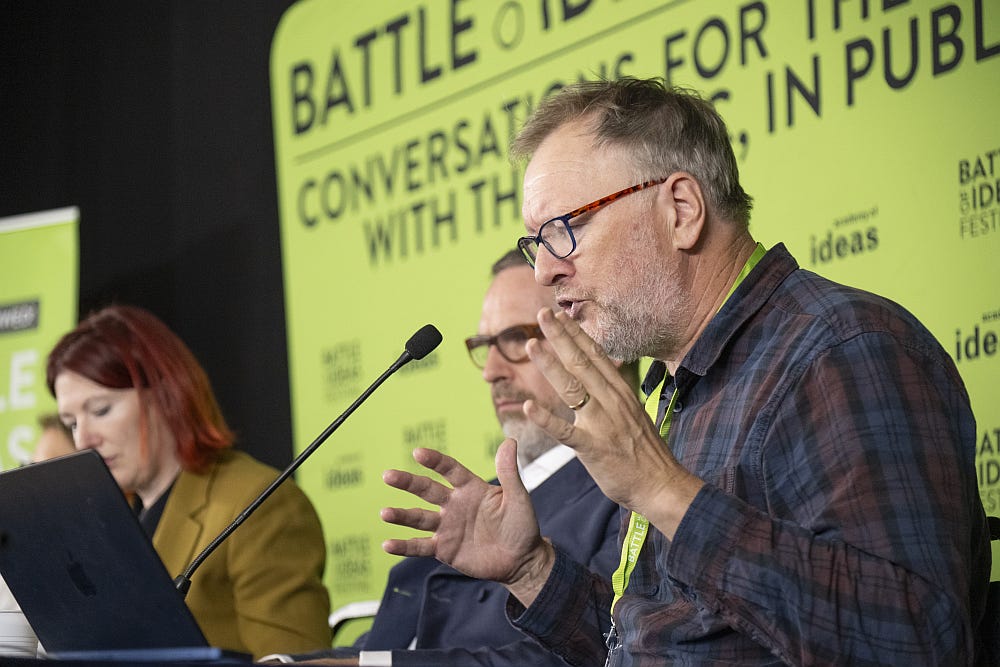
At the Battle of Ideas festival, we explored questions of media bias, whether the new New Media will finally kill off the MSM and asked What has the BBC ever done for us? In the latter, as reported by the Telegraph, an important point of discussion was the BBC’s pro-Palestine bias. One of the speakers, Phil Craig, a BBC graduate trainee who built his career working for iconic British TV series World in Action and Panorama, revealed how his faith in the BBC ‘ebbed away’ as he watched coverage of the Gaza conflict.
Here we publish an extended version of his speech on the issue, and on groupthink at the Corporation and in the media more generally.
I worked at Brook Lapping, a production company, for many years and became joint head of programme there alongside the brilliant Norma Percy. We made many hugely acclaimed series for the BBC and were known for rigour, objectivity and fair mindedness as we tackled the really big stories: the break up of Yugoslavia, the peace process in Northern Ireland, the hostage crisis in Beirut, etc. Norma’s astonishing series, The Fifty Years War: Israel and the Arabs, from 1998 (it is still on BBC iPlayer) had all the key players from 1948 onwards and was shown across the Arab world and in Israel, rare in itself.
I thought about this series a lot during the Gaza war, and the super-high standards of balance that the BBC asked of us back then, and I came to lose a career-long faith in the BBC’s fairness. There are numerous examples we all know, but all the mistakes of tone, hiring and ‘rushing to judgment’ all went in the same direction. Friends inside the organisation still speak of groupthink and the power of the activist younger staff.
I thought about this, too, when Hannah Barnes struggles to get attention for her reporting of the Tavistock gender clinic for children, incredible work that she told me was treated with real suspicion inside the organisation. Former current affairs grandee Fran Unsworth’s recent interview with Rob Burley was important, too, again highlighting the effective veto that an activist class had over the reporting of a very important story. In this case, it was the Tavistock, but there was also a wider friction between the trans movement and women’s rights.
I felt the same pressure toward the end of my TV career in the various industry talking shops and markets I attended or organised. (I was on the board of the Science and Documentary Congress for some years.) Until quite recently (about 2015, I’d say), there was open and vigorous debate about the biggest subjects out there. But suddenly there was a dull conformity and a sense that some opinions should not be shared. To this day, I believe that the Congress has never debated the origins of Covid (a rather important science story) or the many issues connected to the trans movement. Meanwhile, to express any enthusiasm for Brexit is to invite instant personal and professional isolation, and I strongly suspect the same is true inside the BBC now. All of this cannot be healthy, but it all can be remedied by a return to core values and some tough leadership.
A ‘canary in the coal mine’ moment for me was talking to my old Panorama boss - and patron - Mark Thompson at a BBC party a few years after 9/11. I said that I was uncomfortable with aspects of Adam Curtis’s famous Power of Nightmares film because it seemed wrong to equate neo-conservatism in the US with the jihadist movement quite strongly. Mark looked at me as if I’d stepped in something nasty, quickly caught the eye of someone else and that was that. He, of course, went on to scale the heights in London and New York, first as director general of the BBC and later CEO of the New York Times and CNN. And maybe knowing which opinions count and which fall outside the groupthink helped him do just that.
From 2012 to 2015, I ran factual TV for the Australian Broadcasting Corporation (ABC) - very much a mini BBC on the other side of the world - and, from what insiders there tell me now, I sense a similar change in mood after I left. I was especially shocked to see so many of my friends and old colleagues marching during the Gaza war, on one occasion behind a pro-Iranian banner and images of the Ayatollahs. I’m not sure you can do that and then go back to your office the next day at a publicly funded broadcaster committed by its charter to balance and fair-minded reporting.
It was interesting to me to hear a ‘hot mic’ with the ABC’s lead science correspondent last year admitting he had dismissed the Covid lab-leak theory largely because Trump had supported it. I mean, Trump said some astonishingly crazy things about Covid. But if your job is to inform a whole nation about the biggest medical story of your lifetime, you really should be more open minded. And that ‘closing of the media mind’ is something that should worry us all.
Phil Craig is a bestselling author and multiple-award-winning film-maker. He is author most recently of 1945: The Reckoning: War, Empire and the Struggle for a New World.
A good article that underlines just why so many of us have so little trust in the BBC and strongly object to being forced to pay for its so called 'service' despite not using it or wanting it. Far from being proud of the BBC I am deeply ashamed of its 'mistakes', obvious bias and indoctrination of our children. A once respected and cherished institution has and continues to squander the support it spent decades building, it will be much, much harder, if not impossible to win back.