

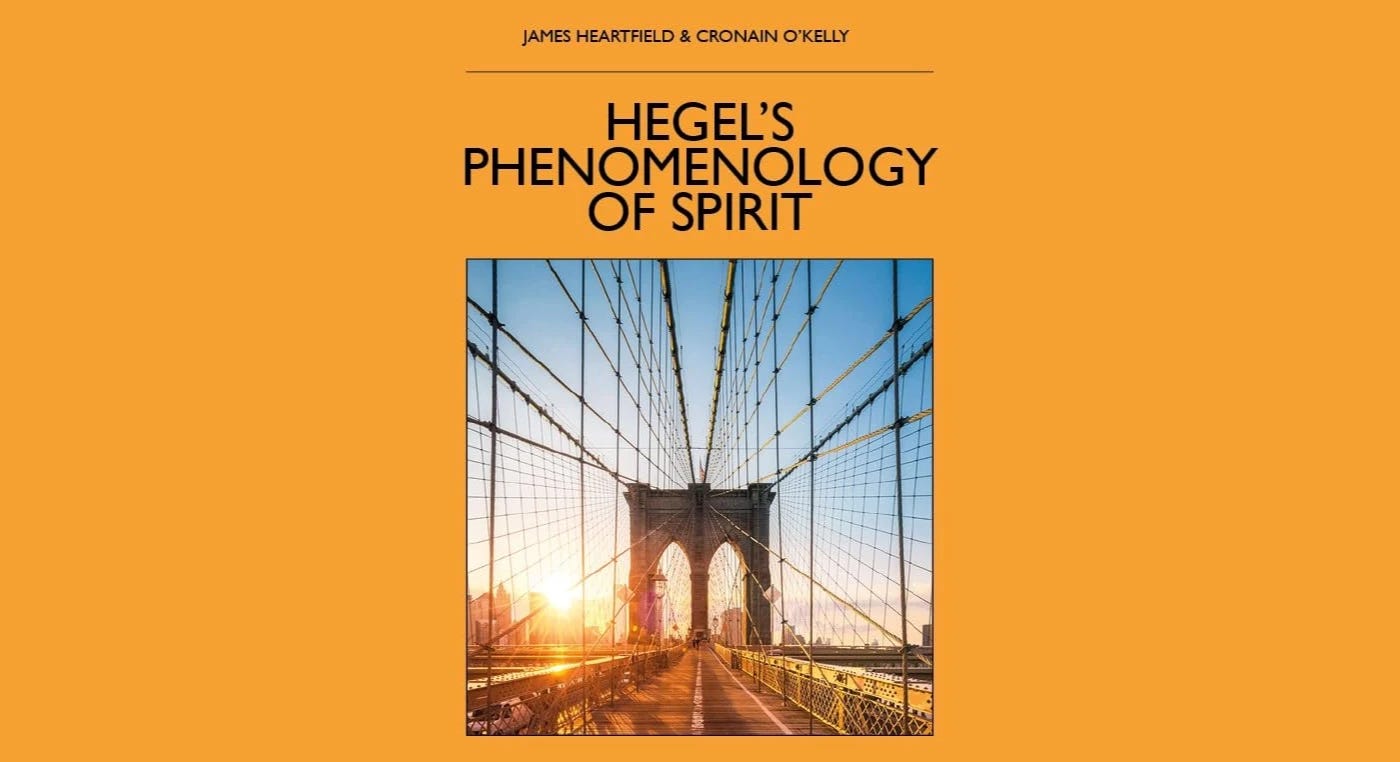
The Battle of Ideas festival is a great opportunity to get to grips with developments in contemporary society. But it is also a chance to take a step back, to understand how we might think about the world, too. Nothing exemplifies that better than our session with the co-authors of a new book, Hegel’s Phenomenology of Spirit. Hegel is a giant of philosophy – but he is not an easy read. In their new commentary, James Heartfield and Cronain O’Kelly seek to understand him and make him accessible more generally, but without being simplistic or lazily trying to make him ‘relevant’.
In this edited version of his introduction to the recent launch of the book, James Heartfield explains how the book came about and how Hegel’s writing has informed the work of many thinkers since.
James and Cronain will the introducing the book in the session Meet the authors: Hegel’s Phenomenology of Spirit on Sunday 18 October. James will also be speaking at Visas for all? Britain’s immigration scandal and Who is council housing for? at the festival.
To find out more about the full programme and to buy tickets (with big discounts for students and concessions) visit the Battle of Ideas festival website.
Claire

Introduction to Hegel’s Phenomenology of Spirit
James Heartfield
Cronain O’Kelly and I wrote this commentary on the German philosopher Georg Hegel’s book, which is called The Phenomenology of Spirit. This book is not just our work. Toby Marshall and Marco Santucci started the Old Hegelians reading group, from which we collected the introductions and edited them into a book.
Hegel’s work is quite hard. It is full of elliptical sentences making excessively particular distinctions, which are hard to keep a hold of. Schopenhauer called it a colossal piece of mystification, and Kierkegaard said it was a magnificent palace built by a man who lived in a nearby guard house.
Hegel joked about the way that the very word ‘philosophy’ had bad connotations as unworldly and trivial. So, there is a lot to put you off. I hope that in this book we have succeeded in letting Hegel’s meaning come out clear without dumbing it down.
One thing a lot of people do when trying to make Hegel more accessible is to emphasise how close his thought is to ours, to make him more palatable. There is a lot of good ground for doing so – for the reason that Hegel is responsible for a lot of the ideas that are around today.
Whether it is ‘reality is a social construct’, Simone de Beauvoir saying one is not born but becomes a woman, or Frantz Fanon saying the wretched of the earth will rise up and remake it, or Edward Said talking about ‘the Other’, or Bruno Latour arguing that the laboratory creates natural laws, or existentialism and phenomenology – all of these have at least part of their origins in Hegel’s Phenomenology of Spirit.
Most celebrated of all, of course, is Marxism, which owes a great deal to the Phenomenology of Spirit.
But here I would like to caution against the temptation to assimilate Hegel to us. I think it helps us to understand him better to see how different he is from contemporary thought, the better to see what is special about him.
One thing, in particular, really makes him very different from us, which is that he believes in God. Not incidentally, but fundamentally.
The Spirit of which he writes in his Phenomenology is God. His argument is that God manifests himself in the shapes that consciousness assumes.
In the Encyclopedia Logic, Hegel writes:
The stages in the evolution of the idea seem to follow each other by accident … but it is not so. For these thousands of years, the same Architect has driven the work: and that Architect is the one living mind whose nature is to think…
Hegel is Ecumenical, or Encyclopedic, or perhaps Promiscuous. All thought is part of his theory.
Not just philosophy. But psychological attitudes, like hedonism or stoicism, also commerce, government, romanticism, family ties, the science, the Enlightenment, the French Revolution, and also religion – ancient religion in Greece, the Old Testament and the Gospels, too.
It is a very democratic approach. Everything is included. Higher thought and everyday prejudice. They are all thought.
There are philosophers, like Wittgenstein or Ayer, who think their job is to exclude error. They act like gatekeepers. They think that truth is like a stockade that must be defended.
But as Hegel said, when they do so they abandon all the territory beyond the stockade to error. And even within the stockade, the truth is limited, diminished and hardens into falsehood.
I might be giving you the impression that Hegel is a relativistic hippy who passes no judgment. Leopold von Ranke thought that every age was equally close to God.
But Hegel is not like that. He is not like a gatekeeper, but more like a slave driver. He sets out to capture all the other philosophers and put them to work on his plantation. Clashing ideas are not chased out, but rather integrated. Rival, contradictory schools of thought are reduced to the status of sub clauses in his larger argument. Just as nobody is wholly wrong, nobody is wholly right, either, just one-sidedly telling a part of the story.
The glue that holds all of these contradictory ideas together is Spirit – like God – so that each stated position, or shape of thought, or school of philosophy becomes a facet of the Spirit.
Maybe ‘glue’ is wrong. It is more like a great river carrying these ideas along. The different ideas are stages on the road that Spirit takes. ‘Phenomenology’ means something like morphology, the shapes that a thing takes – or in this case, the shapes that Spirit takes.
The way that this spirit proceeds is by making itself real, by manifesting itself in these different shapes of consciousness, or schools of thought, and human institutions.
As it perfects these Shapes of Consciousness, pushing them to their limit point, Spirit recognises itself, and also recognises the limitations of each developed idea, and how it must move beyond the settled view, even how these limits themselves suggest what ought to be changed.
So, he writes about how empiricism, which starts with a very passive picture of consciousness receiving the impressions of the outside world, cannot really work unless consciousness is active, however much empiricism denies that. That is how idealism arises out of the limitations of empiricism.
So, too, Hegel explains that the separation of Man and God in the Old Testament suggests the intermediation of Christ that happens in the New Testament. Or that the way that the extremism of the French Revolution, as it eats itself, suggests a more moderate, constitutional reform.
Hegel’s case for God is hard for people to believe in today. Most Hegel scholars and fans like the reinterpretation of Hegel that was first proposed by Feuerbach and taken up by Karl Marx. That interpretation is that when Hegel writes Spirit (Geist, in German) we should not read ‘God’ but ‘Man’.
This anthropological reading of Hegel’s work says that the passage through history is mankind’s. That it is man that who makes these different ideas and institutions. And it is man who looking at what he has achieved, comes into self-knowledge. Man sees the limits of what he has done, and the route through to what he should do next.
The anthropological reading of Hegel is good. I share it.
But we should be careful. You cannot, I think, pretend that Hegel meant Man, when he wrote Spirit. He really did mean God. If we want to understand what he meant, we have to see him clearly and not just assimilate his ideas to ours.
And more than that, something is lost when you anthropomorphise Spirit, and make it mean Man. Marx warned us about this when he said that the Young Hegelians, while they were busy taking the Spirit out of Hegel’s Phenomenology, forgot that Spirit was the active part of Hegel’s theory.
It is Spirit that stops all the different shapes that Spirit takes - Self and Other, Master and Slave, Subject and Object, Freedom and Realism – from hardening into absolute and insurmountable oppositions. Because each is a facet of Spirit, we can move on from one to another. But without that common substance they become rigid oppositions.
In the 1930s, in Paris, Alexandre Kojeve taught an anthropomorphised version of the Phenomenology of Spirit in lectures that were attended by those who would go on to be leading intellectuals, like psychoanalyst Jacques Lacan, sociologist Maurice Merleau-Ponty, philosophers Jean-Paul Sartre and Simone de Beauvoir. Through them, they influenced others, like the Martinican-Algerian revolutionary Frantz Fanon.
But many of those thinkers tended to get stuck in the oppositions between Self and Other. Sartre thought there was a ‘reef of Solipsism’ that made it impossible for one person to see another’s point of view. Fanon thought that it was absurd that colonised people could ever make peace with their former masters, that the overcoming of the positions of ‘master’ and ‘slave’ was a Hegelian fairy story. Here, though, it is Fanon who is being sentimental, not Hegel. Decolonisation happened. And we should not, like Sartre, or Edward Said after him, make the Other into a permanent status.
There is something to be said for Spirit as Hegel meant it, for the transcendental power that refuses to be bound to one position but always strives to take the next step.
Karl Marx, I think, understood that. His version of Hegel’s Phenomenology of Spirit looks forward even to Hegel being de-throned, but in a Hegelian way. This is what he writes in the Communist Manifesto.
All fixed, fast-frozen relations, with their train of ancient and venerable prejudices and opinions, are swept away, all new-formed ones become antiquated before they can ossify. All that is solid melts into air, all that is holy is profaned, and man is at last compelled to face with sober senses his real conditions of life, and his relations with his kind.
James Heartfield is a lecturer and writer. He is author of numerous books, including Britain’s Empires 1600-2020 and co-author of Hegel’s Phenomenology of Spirit (with Cronain O’Kelly).