


This week, media headlines focused on a report from the Tony Blair Institute (TBI) that argued that people diagnosed with conditions such as anxiety, mild depression or ADHD should not be eligible for cash benefits. The report proposed that government should introduce an ‘emergency handbrake’ to cut the number of people who are receiving health and disability benefits. It argues such conditions should be classed as ‘non-work limiting’ - with people offered support rather than money.
Such policy proposals often lead to a backlash and, on cue, charities such as Mencap condemned the proposals, calling them ‘deeply unhelpful and ill-informed’. I am more sympathetic to TBI than those refusing to contemplate any challenge to orthodoxies around the huge numbers now self-describing or being diagnosed through the prism of neurodiversity or mental ill health. But I do agree, we all need to be better informed about this issue beyond headline-grabbing soundbites.
So, the Academy of Ideas was delighted to co-host the book launch of The Crisis in the Classroom: How the special needs explosion is destroying education, a new book by Dave Clements, published by Luath Press. We reproduce Dave’s speech from the launch below. This is an important book because it both passionately argues a viewpoint, but swerves away from an overly simplistic, black-and-white approach. It asks urgent questions on rising levels of diagnosed needs and behavioural difficulties in schools.
Combining personal accounts, cultural analysis and policy research, Dave’s book questions common explanations for where we are and instead calls for a more honest and critical conversation about how best to support young learners, while also calling for a radical rethink of policies and systems that are struggling to respond to a growing crisis in education today.
Dave – a regular speaker at the Battle of Ideas - probes difficult areas, unafraid to take on some sacred cows, querying why there is a surge in children requiring special educational support. Is there a problem of over-diagnosis? Is the explosion of those claiming the label a fashion or a genuine public-health crisis? What’s it really like for children and families living with neurodiversity?
As writer and broadcaster Dr Tiffany Jenkins, author of Strangers and Intimates notes, the book is ‘An urgent wake-up call to the harm the needs explosion is doing to school and our children, from someone with personal experience who can see the bigger picture.’ So, I urge you all to read it. You can order a copy of the book direct from Luath Press here. Further down the page, you can find links to audio from our related Battle of Ideas debates last year.
The Crisis in the Classroom: opening remarks at book launch in Westminster
Dave Clements
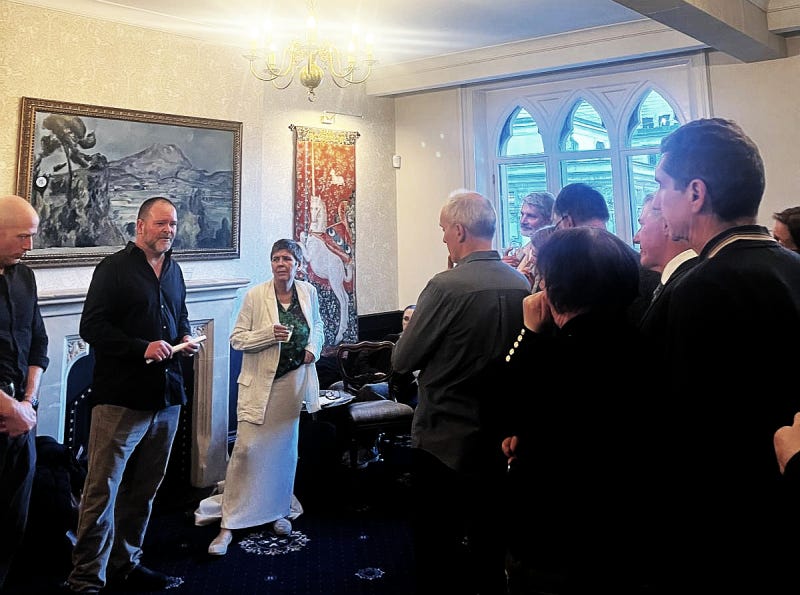
I first presented the ideas contained in my new book, The Crisis in the Classroom: How the special educational needs explosion is destroying education, a year ago at a meeting of the Academy of Ideas Education Forum. I think that was when I first really understood how controversial it might be. Not because I was saying anything intrinsically shocking. Not because they disagreed. But because the teachers among them knew the things that I was saying, and the things that they were saying, could not be said in the staffroom.
And these were the brave teachers, the ones willing to question orthodoxies in education. I spoke to a few of those willing to speak publicly in the book. Indeed, the credit for my writing it at all lies with another teacher, Kevin Rooney. Having read a series of pieces I’d written on my Substack on the subjects of neurodiversity and special educational needs (SENs), he phoned me up and told me I should write a book about it.
We were coming at the subject from different perspectives: Kevin as a teacher troubled by the challenges associated with SEN; me as a parent struggling with the SEN system, and with schools, to get my son the support he needs. That dynamic, I hope, was a productive one – and led to a more nuanced take on the subject than it might have otherwise been.
So, what is it all about?
It’s not about my ‘lived experience’ – others have done that and done it well. At the same time, I think part of the problem we have – and part of the reason that we have what I describe as a ‘needs explosion’ at all – is a consequence of an unhealthy obsession with ourselves and our personal struggles. It isn’t always helpful.
What I do say in the book is that my son has autism spectrum disorder (ASD) and was also diagnosed with ADHD – both in his early school years. Both conditions feature strongly in the needs explosion. There are 1.2million people, children and adults, with autism and 2.2million with ADHD in England.
But I also talk about a whole host of other needs and behaviours that have spiked recently, where they might have come from, and the impact they are having in the classroom.
The book asks more questions than it answers. But they are, it seems to me, important questions and they aren’t really being asked. So that is what I do – I ask awkward questions. The first is the one that most of us are thinking when we read about this stuff, even those of us with kids with SENs.
‘Are they making it up?’
I talk about celebrities with ADHD and autism and those making a career of their conditions online. Are they spreading awareness, or are they just cashing in, or perhaps trying to stay in the public eye, or just making excuses for their dodgy behaviour? There is understandable cynicism about some of the claims being made about what are sometimes called ‘invisible disabilities’, about a culture of entitlement and the growing need for mitigations.
But also, it has to be said that it’s not always that simple. My lived experience of raising a child with a demand-avoidant profile - or what is sometimes called pathological demand-avoidance (PDA) - at least tells me that much. Demand avoidance sounds made-up, and maybe sometimes it is, but believe me it’s also very real and difficult to handle.
So, it’s not just a media or online phenomenon. It is both real for some and a wider cultural problem with real-world impact for others. The trouble is, knowing which is which can be very hard to disentangle.
Do we know what normal is?
The expansion of diagnostic categories can be a good thing - such as the recognition of what used to be called Asperger’s syndrome at the high-functioning end of the autism spectrum. But it can also be a bad thing, as autism specialist Uta Frith recently, and controversially, explained. The autism spectrum is now so inclusive, she said, it has effectively ‘collapsed’. It has become meaningless.
It’s striking how much of this change, this particular expansion of a category of needs, can be traced back to the 1990s. Judy Singer coins the word ‘neurodiversity’. ADHD begins to be diagnosed in the UK. The term Asperger’s syndrome is popularised (until, that is, Hans Asperger’s Nazi links are uncovered). Each time expanding recognised needs still further.
In the postscript, I bring the book up to date with other examples of how this process of needs identification and expansion is playing out now: Mattel releases an autistic Barbie complete with noise-cancelling headphones and fidget-spinner; Alton Towers rows back on its decision not to allow those who say they struggle with crowds (in other words, kids with autism) to skip the queue.
But it’s the crisis in the classroom that I keep coming back to. I ask what’s so special about special educational needs if every child seems to have one? There are 1.7million children in England with SEND, half a million of them with an Education, Health and Care Plan (or EHCP) intended for children with the highest or most complex needs. Some of this is a consequence of more children presenting with ASD and ADHD – placing huge pressure on local authorities, with talk of bankruptcy and bailouts.
That would be challenging enough, but I also talk more broadly about the needy classroom – with rising numbers of exclusions, attendance issues and behaviour problems. It’s an explosion where everything is hitting at once, and in the classroom, in particular.
Where are all these needs coming from?
While schools are not blameless, there are problems affecting young people whose causes lie elsewhere. In a chapter called ‘Beyond the school gates’, I look at the wider context: at the mental-health crisis, the impact of lockdown, the growing welfare crisis, the panic over online influencers, social media and mobile phones, and the debate over boys’ education. I also look at how, despite all the concern and even hysteria, other problems – in communities and in families – go largely ignored.
There are real needs out there, but some of them are misattributed. The rise of identity politics, it seems to me, is a big part of the cause of escalating needs. But so, too, is the collapse of adult authority and any sense that we, as adults, are in this together, and have a collective responsibility for raising and educating our young people. This new politics of self-indulgence, and this failing authority and lack of solidarity among adults, has allowed the explosion to happen and are now getting in the way of containing it and clearing up the damage.
Schools aren’t blameless and neither are local authorities. I talk, as a parent and as a former school governor, about the SEND experience of a constant struggle for support and dealing with placement breakdown; about reduced timetables, school exclusions, and how many parents and children are often left to their own devices (often literally for the kids).
At the time of writing, parents and teachers alike were awaiting publication of a much-anticipated White Paper, and the launch of a consultation on SEND reforms. Their publication brought some good news. The restricting of EHCPs to those who really need them is controversial but a good thing in my view. However, the introduction of so-called inclusion bases (special provision in mainstream schools) is unlikely to meet the variety and volume of needs that kids are presenting with.
I talk in the book about the disruption that the needs explosion inevitably brings for all concerned, and the impossibility of meeting every child’s particular needs in the classroom. I am critical of the failure to tackle the ongoing mismatch of needs with support and provision – and how the ‘inclusion’ and ‘whole school’ ideologies are getting in the way of both children’s learning and of meeting genuine needs.
There are no easy answers to the questions I raise, but as I say in the concluding chapter – we can’t go on like this. The human and financial cost of both failed support and too much labelling are enormous. We need to get to grips with the underlying causes of the needs explosion. And that has to start by acknowledging that we have a problem. Too many are avoiding the issue or pretending that we can just throw more resources at it.
In the course of preparing for and writing The Crisis in the Classroom, I spoke to teachers who understood how bad things have got. But many are too nervous to speak out. They know it is taboo to ask questions. Others are admirably eager to appear autism-friendly, to go on the training, to accommodate fidgety ADHD kids, and attend to each and every ‘difference’ the kids in their classroom present with. There’s nothing wrong with this up to a point. But I think we’ve reached that point.
Listen to related debates
Battle Book Club: No More Normal – Mental Health in an Age of Over-Diagnosis
Battle of Ideas festival 2025
Should there be a mental-health professional in every school?
Battle of Ideas festival 2025
