

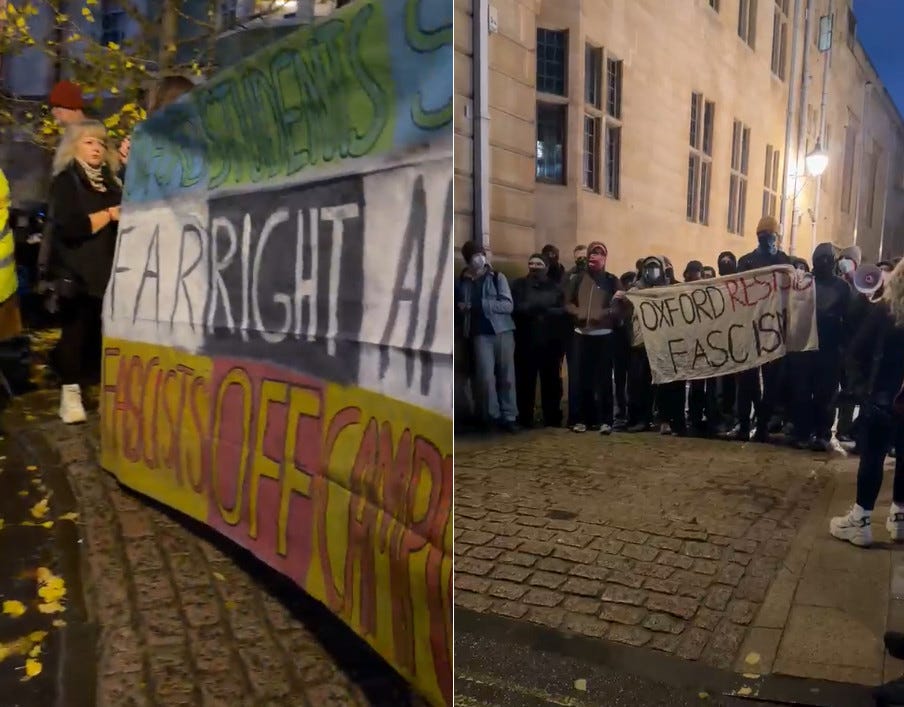
Last week, events in Oxford demonstrated to the authors of the Higher Education (Freedom of Speech) Act 2023 that a law is only as effective as the institutions willing to enforce it. A talk by Nathan Cofnas – a self-described ‘race realist’ – organised by the Oxford Reform Society, was besieged by protesters, who prevented some people from attending and led to scuffles and assaults.
To its credit, Oriel College was unequivocal in its position that it had a legal duty to allow the event to go ahead: ‘Oriel College is committed to upholding freedom of speech within the law and has a statutory duty to do so. This includes the freedom to express views that many find deeply offensive.’
Yet Thames Valley Police initially maintained that the college ‘retained responsibility’ for managing the inevitable mayhem at the event. The police, who continue to be the nation’s most reliably surprised-by-everything institution, apparently failed to anticipate that a speaker accused by progressive activists of organising a ‘lynching’ of the late Professor Jason Arday might attract a protest beyond the capacity of Oriel College’s two door porters to manage.
This was, after all, a national news story. The protest was being organised not by a student society but by Stand Up To Racism, a national campaign organisation, while petitions calling for the event’s cancellation had attracted the signatures of prominent politicians, including Jeremy Corbyn and Diane Abbott. On the other side, more than 170 academics had signed a letter coordinated by the Free Speech Union in support of the college’s decision to uphold freedom of speech.
Oriel College has neither the authority nor the means to police protests taking place beyond its own grounds. That responsibility lies with the police, whose duty is not merely to maintain public order but to protect the rights of those exercising their lawful freedoms, including freedom of expression.
With the event due to begin at 6pm, the last attendees reportedly managed to break through the protesters’ blockade at around 5.30pm to enter the college. The lecture went ahead, but to an audience of only around two dozen people, in a hall reportedly just a third full. Many of those who wanted to attend had been unable to get past the mob.
Yet it seems it was not until 7.25pm, almost two hours after the last attendees had forced their way in, that police were finally attempting to contain the protesters on Oriel Street.
In familiar fashion, the police appeared to have taken the path of least resistance, accommodating the most disruptive protesters rather than protecting the rights of those who the protesters sought to silence. In this case, they seem to have abdicated that responsibility, allowing a blockade to continue while attendees reported being assaulted and intimidated. Oriel’s own head porter was reportedly injured protecting students and the college.
The protesters had, in effect, exercised a heckler’s veto. Having failed to persuade the college to cancel Cofnas’s talk, or to discourage students and members of the public from attending, they instead sought to prevent people from entering the college through physical obstruction, intimidation and the threat of violence. And, to a considerable extent, they succeeded.
Indeed, one student quoted by The Oxford Student seemed to have hoped that the threat of disorder would force the university to call off the event on grounds of student safety, effectively circumventing the Higher Education (Freedom of Speech) Act. He described it as a ‘shame’ that the event had gone ahead, saying that safety concerns had been raised, which he had hoped would be enough to secure its postponement or cancellation, but the ‘university saw differently’.
The threat of disruption and violence was significant enough for protesters to invoke it as grounds for cancellation, but apparently not credible enough for the police to take adequate precautions to protect those attending the event.
Only last week, the home secretary, Shabana Mahmood, announced stronger guidance on police impartiality to tackle what she called the ‘corrosive and growing perception of two-tier policing’. She acknowledged that ‘there have been examples of differential treatment’ by officers, which have allowed ‘some to whip up the false idea that there is two-tier policing in this country’. Two-tier policing is, of course, a dangerous myth, except when the home secretary admits that it happens or when police are given guidance to stop it from happening.
In this case, it is hard to imagine the police acting with the same indifference had campaigners on the hard right attempted to prevent students from attending a university event – wearing balaclavas, using violence and intimidation, and physically obstructing the entrances. One suspects the police response would have been considerably swifter and more forceful.
The right to freedom of expression cannot depend on the political sympathies of those trying to suppress it. Nor can it depend on whether the police happen to agree with the person attempting to exercise it. By failing to protect students’ right to hear a controversial academic speak – and (whisper it) even challenge his views – and to uphold the principle that taking offence is not grounds for cancellation, Thames Valley Police appear to have made a political judgement rather than upheld the law as it is written.
The lesson of Oriel is that laws and institutions alone cannot guarantee our freedoms - even when, as in this case, the law has been changed in freedom’s favour. Freedom also depends on cultivating a culture in which people are willing to exercise and defend it, even when doing so is uncomfortable.
That’s exactly what we’re trying to do at Living Freedom, where we believe every generation must renew freedom for its own times. Do subscribe to our Substack to stay up to date with our events.
Jake Weston is event coordinator at Living Freedom.

Disgraceful conduct by the UK Police. Totally in contrast to every single left-leaning protest.
“ Baroness” Fox,you should make it clear that this “ Academy of Ideas “ was set up and financed by Viktor Orbans Fidesz.