

If you are interested in politics and like reading fiction, a couple of treats.
The next Academy of Ideas Battle Book Club will be discussing A Better Life by Lionel Shriver on Tuesday 30 June from 6:30 pm - 8:00 pm (via Zoom). The discussion is free to join and offers an opportunity to unpick questions of immigration and integration, home and community, responsibility and ambition. Find out more and register here.
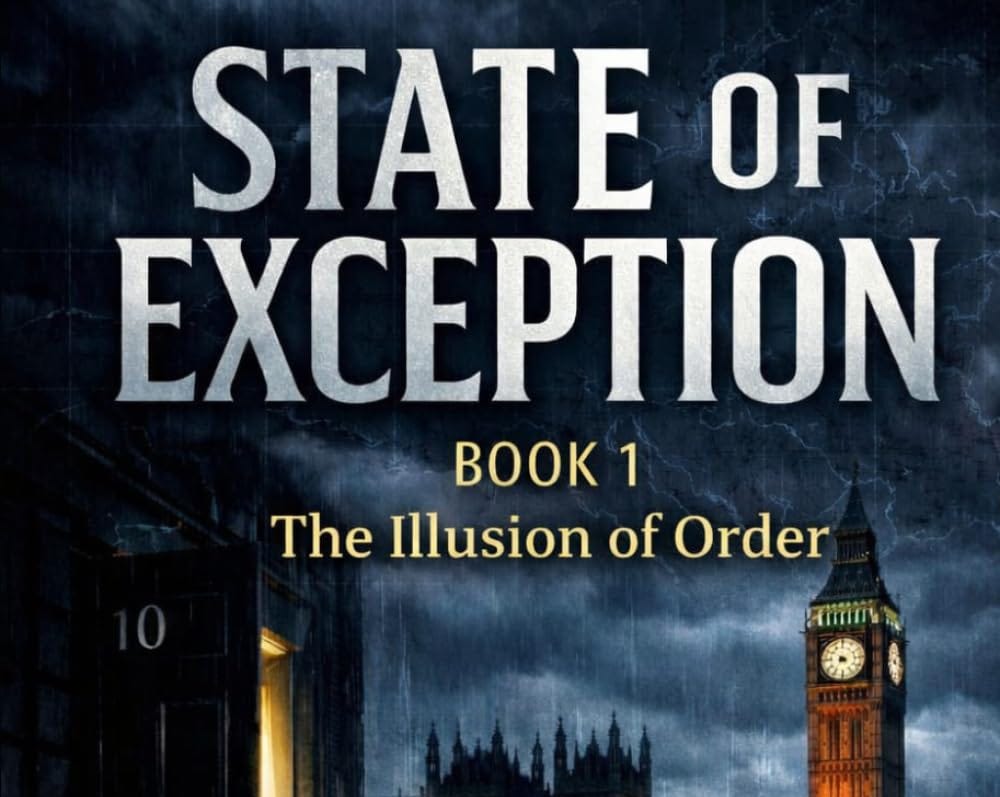
Meanwhile, an Academy of Ideas member and political activist, who writes as J.R. Turner, has written a political thriller, State of Exception. Here, he explains why he wrote it and its themes below.
Claire
How I accidentally wrote a political thriller
J.R. Turner
I did not set out to write a novel. I set out to get through a period of my life when my own mind would not switch off.
When my mother was diagnosed with cancer, I needed somewhere to put my thoughts that was not the diagnosis itself. I started writing – not with a plan, not with a publisher in mind, not even with a clear sense of what the story was. Just a character, a situation, and a political world that felt uncomfortably close to the one outside my window.
That was the beginning of State of Exception.
I wrote it chapter by chapter, mostly during the hours when sleep would not come. The story kept growing. Characters became real to me in the way fictional people sometimes do – not as constructs, but as people with pressures and histories and things they were trying to protect. The political world sharpened. The stakes got higher. By the time I put it all together, it was nearly a quarter of a million words, and had to become a duology.
I never thought of myself as a novelist. I am still not entirely sure I do. Which is perhaps why I write fiction as J. R. Turner – a small but necessary distance between the person who has to answer questions in public life and the one who gets to ask them on the page.
State of Exception follows a British prime minister navigating a series of crises that arrive, not one at a time, as they might in a more orderly world, but simultaneously and in ways that make each one harder to manage because of the others. A security threat. A constitutional rupture. An international situation that refuses to stay contained. A parliament that senses weakness and begins to move.
The prime minister at the centre of it is not a hero in any clean sense. He is competent, principled, and genuinely trying to do the right thing – but the novel is less interested in whether he succeeds than in what the effort costs him, and what it reveals about the system he is trying to hold together. His family are present throughout. So are his closest advisers, his Cabinet, his political opponents and the international figures applying pressure from the outside. The cast is large because the situation demands it. A crisis of this scale does not resolve in one room.
What interested me most in writing it was not the drama of the events themselves – though I hope the drama is there – but the machinery underneath. The way decisions actually get made in government. The way information moves, or fails to move. The way institutions that look solid from the outside can be revealed, under pressure, to be held together largely by convention and the willingness of people inside them to keep behaving as though the rules still apply – and what happens when that willingness starts to erode.
I work in politics. I have spent a long time paying close attention to the gap between what it looks like from the outside – the statements, the briefings, the performances – and what it actually feels like from inside the room where the real choices get made. That gap is where the novel lives. Fiction gave me the freedom to explore it in ways that a political speech, or a policy document, never could.
The themes that run through it are not ones I chose deliberately. They emerged from the story as I wrote it. Power and how it changes people. Loyalty and where its limits are. The difference between defending an institution and hiding behind it. The cost of leadership when the situation is genuinely hard and the easy options have already run out.
And underneath all of it, a question the book keeps returning to without ever quite answering directly: when a democratic system comes under serious pressure, what actually holds it together – the rules, or the people?
Book One is out now. Book Two is almost ready, and picks up directly where the first left off – the crises are not resolved so much as transformed. And somewhere in the insomnia that started all of this, an outline for a third novel, entirely unrelated to this one, has already begun to take shape.
I did not expect any of this. I started writing to get through something difficult. What I found, somewhere along the way, was that the story had more in it than I had put there – and that finishing it felt like it mattered, in a way I had not anticipated when I began.
Some distractions, it turns out, have more life in them than you expect. If a political thriller by a new writer is your cup of tea, you can buy State of Exception: Book 1 via Amazon.