

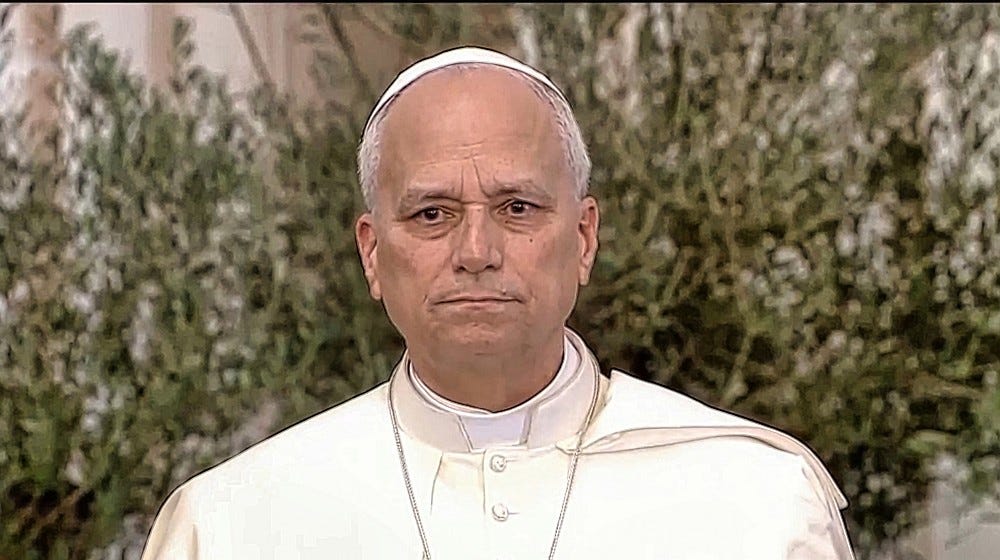
On 16 May, Pope Leo XIV published a new encyclical – a letter to all Catholic bishops and directed to the wider church – on the question of artificial intelligence. Usually, grand statements from the Vatican on social issues are scarcely worthy of comment, with a tendency to echo the latest liberal orthodoxies that is second only to the Church of England – but this one has some merit.
First, the title: Magnifica Humanitas: of His Holiness Pope Leo XIV on Safeguarding the Human Person In The Time Of Artificial Intelligence. At a time when humanity is definitely not widely regarded as ‘magnificent’, this is a welcome cheer for the human race. Only a couple of weeks ago, we were celebrating the hundredth birthday of Sir David Attenborough. It is a sign of the times that a ‘national treasure’ can also believe humanity is a ‘plague on the Earth’.
Second, this is a serious attempt to prompt an ethical discussion about what we should do about AI. There are lots of practical problems with AI, such as its capacity to ‘hallucinate’ facts and references (or to simply get things wrong) and the problems of plundering the copyrighted works of writers and artists to train on and regurgitate in different form.
There is also the question of what happens to source websites that rely on advertising when your search engine (looking at you, Google) jumps in with AI-powered answers culled from these sites. What is the business model if advertising is no longer a viable funding source because these sites get far fewer visitors? Will AI ultimately diminish the very sources it relies upon?
Nonetheless, the potential for AI to make our lives easier is there. We need to figure out what it is good or bad at and how best to use it. Given the energy demands that data centres place on electricity grids now and in the future – apparently, nearly a quarter of Ireland’s electricity is already used to power data centres – what does that mean for the future of energy production?
But beyond these practical questions, few world leaders are in a position to step back and approach an ethical discussion of AI. On that point at least, the encyclical could prove to be a useful focus for debate – especially as a human-centred view.
In one of the most quoted passages, the encyclical says:
Technology has the power to heal, connect, educate and protect our common home; but it can also divide, exclude and generate new forms of injustice. In the abstract, technology in and of itself is not a solution to humanity’s problems, just as it is not inherently evil. In practice, however, technology is never neutral, because it takes on the characteristics of those who devise, finance, regulate and use it. Therefore, the primary choice is not between a ‘yes’ or ‘no’ to technology, but rather between constructing Babel or rebuilding Jerusalem; between a power that claims to dominate the heavens and a people who work together in the presence of God to rebuild the walls of fraternal coexistence.
Now, I handed in my membership card for The God Squad a long time ago, so I don’t really worry that we’re not building AI ‘in the presence of God’. But making sure that AI doesn’t lay waste to everything in its path, that it actually serves people, seems like a worthwhile aim.
For example, it seems reasonable to wonder about a future in which war is conducted using autonomous weapons. As Ukraine has shown, getting good at drone warfare can be enormously useful for those countries that can’t put millions of soldiers and thousands of tanks and aircraft on to the battlefield. But if autonomous drones and other weapons can slaughter at will, who’s in charge? What’s left of the moral element of the decision to kill or not to kill? You don’t have to envisage a Terminator-style takeover by the machines to have some concerns about all this.
Some kind of regulation of what AI does and how it handles data seems appropriate. On the other hand, since we’re still fumbling around figuring out what AI is and what it can or can’t do, premature and heavy-handed regulation could make it harder for startups to exploit the power of the technology, leaving the field to massive companies with well-funded compliance departments. There is a risk that in wanting AI companies to ‘play fair’, the massive incumbents are allowed to rule the roost when a powerful restraint on them – competition – is held back.
There is much to talk about around these issues and the Battle of Ideas festival on 17 & 18 October in Westminster will be a great place to have these conversations. The AoI team has just had a big Battle of Ideas programming meeting and AI will be one of the major topics up for discussion, along with the big issues in politics – both domestic and international – economics, the arts and culture, science, the media and, above all, free speech. Early-bird tickets are still available so please buy yours now and join the conversation!