

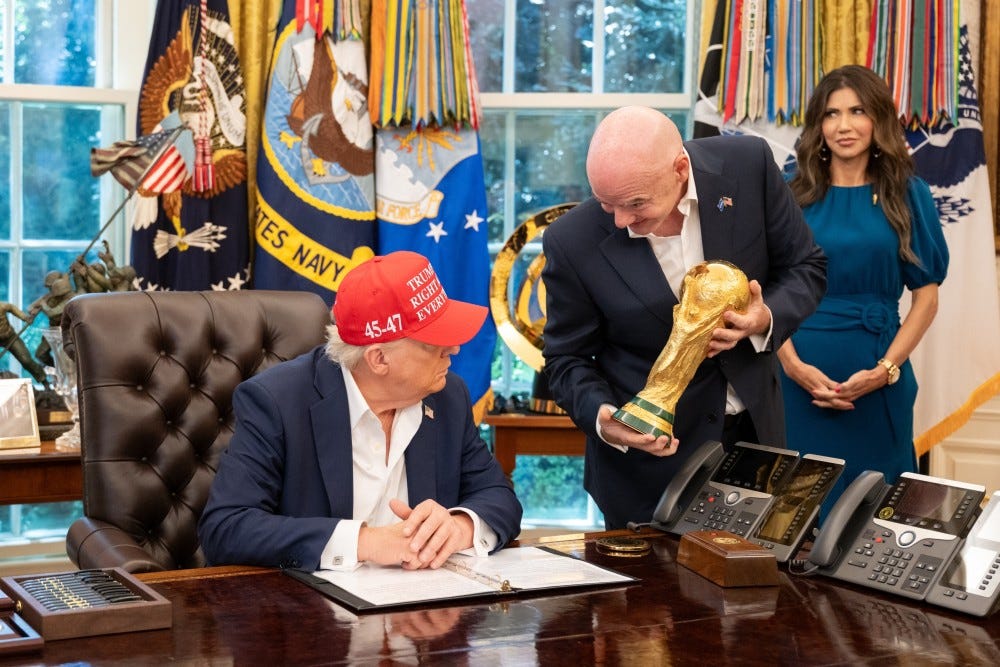
‘Football belongs to the fans. It always has, and it always will.’ Andy Burnham’s response to a proposal from Gianni Infantino – president of football’s governing body, FIFA – to spin off the organisation’s commercial operations has been widely praised – and echoed by figures across the political aisle. The politics makes sense: football is our national game, and greater commercialisation of international football would seemingly only serve the super-rich. It’s an unpopular proposal. But unfortunately, it is often not the fans who get to decide what happens in the beautiful game.
After a successful World Cup across the US, Mexico and Canada, FIFA is keen to attract even more investment to its tournaments. It has announced plans to create a new commercial subsidiary, FIFA Forward Enterprises (FFE), which would assume responsibility for the organisation’s commercial operations, including the World Cup. Under the proposal, FIFA would be able to sell a minority stake of up to 21 per cent in the new company to private investors, raising around $4.2 billion.
For the first time, outside investors would acquire a direct financial stake in the commercial revenues generated by football’s governing body, creating not only an incentive but arguably an obligation for the World Cup to become even more beholden to commercial interests. Who is really benefiting from this plan: the fans, the players, the game in general – or the administrators, big companies and financial advisers? The members of UEFA, European football’s governing body, have responded by voting to boycott the World Cup if the plans remain in place.
All that said, does football really ‘belong to the fans’? Legally, not metaphorically, the answer is: it doesn’t. FIFA is a private association incorporated under Swiss law. It is owned by neither fans nor governments. Its members are the 211 national football associations, which elect the FIFA president and Congress. Fans have no formal governance rights.
Across the world, we’re living through a total collapse of civic virtue. In reality, football has never formally ‘belonged to the fans’ because few ever thought it needed to. We assumed those governing the game would represent us because we assumed they understood that sport is something greater than a business – it has a higher purpose. It’s why we often refer to those who govern professional football as the ‘stewards of the game’. Intrinsically, at least, it isn’t theirs. They do not own it. They are stewards of something greater than themselves, something that existed before them and will exist after them. But in a hugely popular sport like football, the administrators have not always lived up to their duty.
If you believe that widespread condemnation means this plan is certain to fail, let me introduce you to a cricket fan. English cricket has already been bastardised in the name of commercialisation, despite fans’ pleas to stop. Soon, the Mumbai Indians London will face the Manchester Super Giants in a competition called The Hundred. Confused why the London team is called Mumbai Indians? Or what ‘Super Giants’ has to do with Manchester? Or what The Hundred even is? That’s soulless commercialisation for you: the game you love, sold to the highest bidder to do with as they please.
Let me introduce you to this third-generation Chelsea supporter. My club was sold to the highest private equity-backed American bidder. Our young players are sold in the name of financial engineering to make way for faceless recruits who are themselves moved on a year later. Goal music now intrudes upon the most precious moment in football. Our chairman, Todd Boehly, owns a ticket resale business while season ticket holders are penalised for transferring tickets to friends. Parts of club football are now scrambling to regulate practices that never previously required regulation – we weren’t prepared for, nor did we anticipate, private equity coming for our football clubs.
As football fans, we have a sentimental attachment to our teams, whether it is the clubs playing every week or our national teams. An unfavourable outcome after 90 minutes of 22 men kicking a ball around can ruin our weekends. We can just about tolerate rising ticket prices and TV subscriptions because clubs buy better players and standards rise. The English Premier League is the most popular in the world as a result.
But our tolerance is limited when our clubs are used and abused by big-money owners and our international competitions are undermined by administrators who seem suspiciously like they’re on the make.
This is one of the topics we’ll be discussing at the Battle of Ideas festival at Church House in Westminster on Saturday 17 & Sunday 18 October. Tickets are available here.
The commercialisation of the World Cup (and much more) was covered in our World Cup Podcast of Ideas. Listen here: Episode 1 | Episode 2 | Episode 3 | Episode 4
