

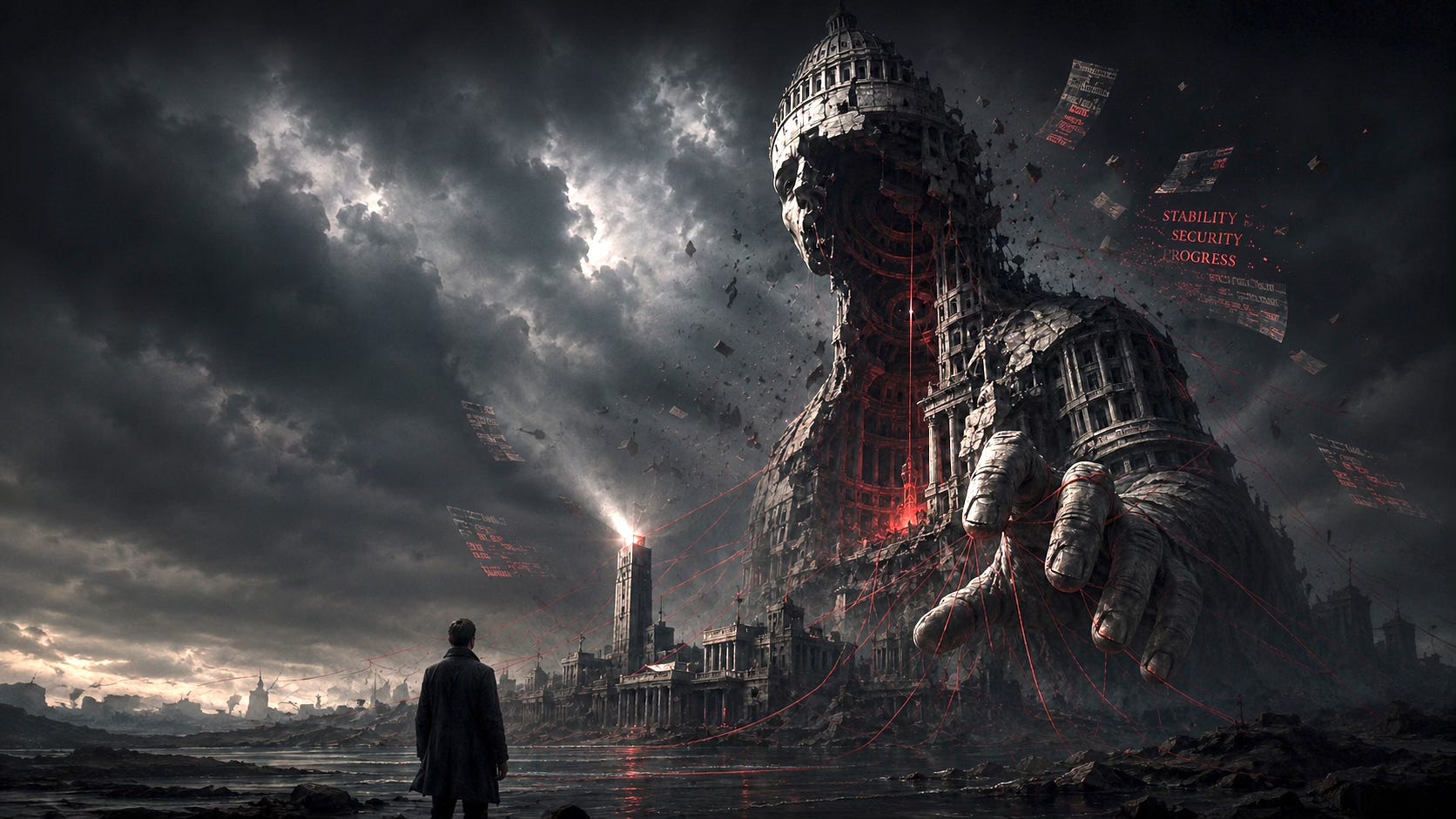
Each year, The Academy – an intellectual retreat which is an initiative of the charity Ideas Matter – takes a major intellectual theme and interrogates it through history, philosophy and literature. This year, we look at the idea of the ‘Hollow Leviathan’: the feeling that the contemporary state and government is degenerating, less and less able to deliver basic goods, and more desperate to maintain control.
This essay, originally delivered as a speech at Living Freedom Summer School last weekend, examines how the severe pressure the establishment is under drives ever-more expansive attempts to maintain narrative control.
The Academy 2026 takes place at Wyboston Lakes, Bedfordshire, on Saturday 22 and Sunday 23 August. Early-bird discounts are available until Sunday 26 July. Get tickets here.
Perhaps the central battleground of contemporary politics is the need of our political elites to control the narrative. Primarily, the role of establishment politicians is not to deliver changes and reforms, not to fix problems identified by people in their everyday lives, and not to change circumstances such that they can attract votes, but to maintain narrative hegemony.
Crucially, this differs from previous attempts to maintain ideological hegemony – that is, to win the societal ‘battle of ideas’ – because ideological warfare was always related to the real world. For example, Stalinism’s ideological success was demonstrated in defeating the Nazi industrial machine at its own game, capitalism defeated communism by offering unparalleled standards of living, social democracy was ideologically effective to the degree it demonstrated you could balance both the demands of organised labour with those of economic growth.
By contrast, the attempt at narrative hegemony treats the political realm purely in the domain of information management. This is a political class that has given up on shaping the world and instead looks to shape the narrative.
A variety of attempts to maintain control of the narrative
The news cycle is full of examples that demonstrate that contemporary elites are concerned, above all, with controlling the narrative. Three suffice.
First, there was the recent confirmation of a story which many people had assumed for a long time, although was widely dismissed as a conspiracy theory. The British government has a special division, run out of Whitehall, called the Research, Information and Communications Unit (RICU). The job of RICU is to intervene with victims of potentially ‘racially inflammatory’ crimes and make sure that they ‘calm community tensions’. You could call this the ‘don’t look back in anger’ unit – its job is to make sure that government, victims and the media all stick to a story which encourages people to avoid asking difficult questions.
This unit has been involved in creating media narratives in conjunction with the press, public campaigns like plastering London in posters following the 2017 London Bridge attack, and working with victims’ families (such as the families of Henry Nowak) to write their statements to the press. In all such cases, the RICU unit serves to further the interests of state multiculturalism, force-feeding the public with the message that ‘division’ and ‘demonisation’ are the primary issues, rather than government policies on migration and multiculturalism.
Second, the Department for Media Culture and Sport released a proposal with an almost innocent-sounding name: Watch this space: a new strategic direction for UK media.
It proposes a ‘prominence regime’ for ‘trustworthy’ news on social media and video-sharing platforms. It would make news from public service media plus other ‘trustworthy’ providers ‘prominent and easy to find’. It gives the example of national and local news publishers appearing near the top of people’s social media feeds when they search for news, especially during ‘social unrest or crisis’.
The DCMS worries that online news is now heavily shaped by algorithms, that misinformation and echo chambers can worsen ‘polarisation, conflict and division’. The government will explore legislative options for a news-specific prominence regime on social media. The proposals explicitly raise whether this should be ‘ongoing and always on’ or only active in periods of crisis, and whether users should be allowed to switch it off.
A third example, which although I take from America is extremely relevant here, is the reaction to the brutal murder last year of Iryna Zarutska by Decarlos Brown Jr, a 14-time offender who was repeatedly set free by authorities under the influence of defund-the-police style racial-justice policing policies. Despite the case being an enormous sensation on social media, it took 18 days for the New York Times to comment. When it finally did, the article was a monstrosity of moral evasiveness. ‘A Gruesome Murder in North Carolina Ignites a Firestorm on the Right’, ran the headline, with the piece engaging in a bizarre detour to talk about the ‘egregiously exaggerated stories about Black criminality’ in the Jim Crow era.
The NYT was not alone in preferring to talk about the reaction to the attack rather than the attack itself. Elite barometer Politico went with ‘Ukrainian refugee killed in North Carolina gets dragged into political messaging war’, while Axios complained of ‘MAGA influencers seeking to elevate the issue of violent urban crime’. CNN, not to be outdone, produced this horrific example of the shiftiness of the passive voice: ‘How the lives of a Ukrainian refugee and a Charlotte man with a criminal history converged in a fatal stabbing.’
Clearly, the regime media was concerned above all with ensuring that no one draw any political consequences from the stabbing, which had been going viral on social media for almost a whole week. The issue for these outlets, when it became impossible to simply ignore the issue, was to ensure that widespread concerns about urban criminality, ineffective justice policies and the withdrawal of law and order prompted by the Black Lives Matter movement did not get a hearing. Such concerns are merely ‘right-wing firestorms’ and part of a regrettable ‘political messaging war’.
A very similar logic was seen in the days following the murder of the French student Quentin Deranque earlier this year by Antifa thugs. He had been attending a demonstration organised by a group of young women, and had come along lest they face any trouble. This man was simply murdered in cold blood by a premediated attack of Antifa militants, who picked him out, followed him home, and ambushed him 12-to-1 before kicking him in the head until he was dead. The mainstream French media reported that a far-right activist had died after inciting a confrontation.
In these examples, I don’t even have to mention the explicit censorship systems which now rule the Western world, such as the Online Safety Act or the EU’s Digital Services Act.
What drives attempts at narrative control
What is driving this? Why such a desperate need to exercise total narrative control?
The key to this issue, is, in essence, the following schematic: the established political class are unable to reckon with the sources of their unpopularity, and must employ ever more comprehensive attempts to provide a foundation for their deeply unpopular rule, because they face total destruction. The stakes are existential for them.
One of the fundamental driving facts of contemporary politics is that the ideology of the ruling class is thoroughly discredited. The political pressure on the ruling class is, across the West, extreme. They face, if not electoral annihilation, then electoral defeats to populist forces who, until recently, would have been totally marginal.
But the response of the political mainstream does not include the possibility of introspection. While they might be capable of asking the question why they are unpopular, they are incapable of answering it with a hard look at themselves.
At the same time, this ruling class certainly feels itself under sustained pressure. To invoke the language of Marxism, they feel threatened not just as a government, but as a class. Their class position – their position as the dominant political and economic group in society – is under threat.
These two facts – the inability to look in the mirror and the dread they feel at the approach of a new order – give rise to a response which at the same time focuses their efforts on political messaging and licenses extreme measures. Put together, this sets the stage for some of the most profound and most desperate attempts to control speech that we know in mature democracies.
Because they cannot avail themselves of introspection, they must come up with a particular explanation to understand their unpopularity. They need, to borrow a term from philosophy, an ‘error theory’ – that is, a theory for why it is that their programme, policies and worldview face such opposition. If they are on all issues fundamentally correct, why do people not agree with them? What explains the errors that the populist masses make?
The explanation is, in the time-honoured fashion of anti-democrats since Plato, that the voting masses are not just wrong, but also misled. The masses do not really disagree with the experts, they just lack the skills and knowledge to perceive what the experts have already decided is the truth. The masses have been tricked – tricked by sophists, by propagandists, by the internet, by Elon Musk, by Russians, by populist charlatans. They have been fed a diet of propaganda, hoodwinked by adversarial algorithms, fallen prey to foreign misinformation.
Therefore, the most important task for the ruling class, anxious to solve the problem of the erroneous masses, is to ‘fix’ the narrative imbalance. The problem of political disagreement becomes a problem of political messaging. If the truth has already been decided, but people still don’t see the light, then we need special techniques for bringing the masses to see the truth. Controlling the narrative – arranging what can be seen, heard and said – becomes not an alternative to democracy but the better substantiation of its essence.
At the same time, the class interest of the establishment is keenly felt by them all. This is not merely a possible change of government afoot but a change of regime. We are not talking about different shades of the postwar consensus, but a desire to overturn it entirely. Given how much the stakes have been raised, the available tools have become proportionally more powerful. Things that would have never been conceivable before in democratic peacetime – dawn raids over private messages, the use of the world’s most powerful technologies to change the debate in real time, gagging orders on the press so powerful their existence cannot even be mentioned – have become fair game in the contemporary political contest.
These two features come together to mean that the establishment classes are thus both psychologically and personally motivated to establish ever more elaborate and intrusive schemes for controlling the narrative.

Three strategies of control
We can group these tactics together under three banners
A. Strategies of control
B. Strategies of deception
C. Strategies of delegitimisation
The strategies of control are perhaps the most obvious – the various forms of soft and hard censorship, regulation of the internet and other communications.
The strategies of deception are also quite straightforward to spot. We have already mentioned the ‘don’t look back in anger’ unit, but we should also note the government supply of industrial-grade misinformation. One examples is the Office for Budget Responsibility (OBR) modelling the impact of migration by using info on migration from 20 years ago, ignoring, for example, care workers who bring 15 dependents. Another is the refusal to publish crime statistics broken down by nationality and migration status. NGOs are also part of these strategies of deception.
But so far we have said less about the strategies of delegitimisation. The most obvious example here is the hysterical moral panic around ‘foreign disinformation’ and the attempt to turn all critics of the establishment into various versions of stooges of Vladimir Putin (or, more recently, of Donald Trump). It literally does not compute for the establishment to see mass discontent as the logical response to their despotic and failed policies, and so the possibility that this as all manipulated by Russia or funded by shady Trump-aligned forces is the only logical step.
Beyond controlling the narrative
This story – a story of a political class engaged in what is effectively an all-out war for survival – seems bleak enough. But it looks increasingly likely that as the narrative control efforts fail, they will intensify their work in more radical directions.
Indeed, the past few days gives us an indication into how Andy Burhnam – who is said to have a more ‘mature’ understanding of the problems of establishment politics – plans to deal with mass discontent. Burnham’s solution is to re-orient the Civil Service away from London. But the small print reveals this is less about devolution than a desire to make the Civil Service less responsive to any future Reform government: Politico reveals he aims to ‘rewire’ the Civil Service to head off Farage.
This is just one part of a playbook now well-established in continental Europe. Macron has led the continent in ‘future-proofing’ the state against populist adversaries: key political allies of President Macron are being appointed to the top of major French institutions like the courts, the national bank and the armed forces.
But in addition, British bureaucrats will be considering adopting the whole continental package: mobilisation of paid Antifa to attack political opponents, the use of lawfare against opponents such as banning and financial investigations, and the solidifying of the deep state.
Reasons for optimism
Despite this dark picture, we actually have reasons to be far more optimistic about what the future holds. Ultimately, the reason for all of the efforts at narrative control is that the establishment have already lost the ideological battle, and their desperate attempts stem from the anticipation that they are about to lose the political battle as well.
The reason they lost is twofold. On the one hand, the impact of their policies have become unavoidable. On the other hand, a tremendous rebellion has taken place among ordinary people, fuelled by the tenacious work of an insurgent ideological counterweight.
Their fear is the justified fear of the losing party. They are terrified because of the enormous cumulative work of the great populist revolt. Just as the night is darkest before dawn or the cornered animal is capable of great violence, the established order is, I think, on its last legs. This means we should be both watchful but also cautiously optimistic.
Ultimately, the reason for elite panic is the mass of popular discontent. It is this desire for something profoundly different that is the condition for all our efforts to overturn the narrative hegemony that we would otherwise be subject to.
Jacob Reynolds is convenor of The Academy, taking place on 22 & 23 August. Tickets and more here.
Each year, The Academy – an intellectual retreat which is an initiative of the charity Ideas Matter – takes a major intellectual theme and interrogates it through history, philosophy and literature. This year, we look at the idea of the ‘Hollow Leviathan’: the feeling that the contemporary state and government is degenerating, less and less able to deliver basic goods, and more desperate to maintain control.
Early-bird discounts are available until Sunday 26 July. Get tickets here.
The Academy 2026 takes place at Wyboston Lakes, Bedfordshire, on Saturday 22 and Sunday 23 August. Early-bird discounts are available until Sunday 26 July. Get tickets here.
I have just visited the RA summer exhibition. As ever an enjoyable experience.
However I wondered where the dissident, anti- establishment artist was… it was all bland, peddling the main narrative.
Are these artists with free minds gone? Or are the curators too worried to showcase their work?
Great analysis, Jacob.
Have cross posted
https://dustymasterson.substack.com/p/master-and-commander
Dusty