

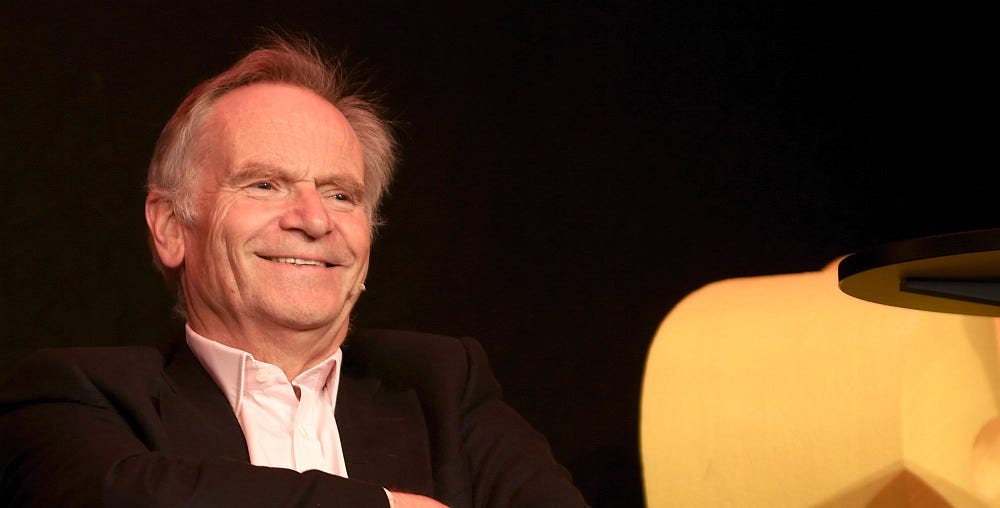
Jeffrey Archer was something of a ‘Marmite’ figure. Nonetheless, he sold more than 300million books across his career, including best sellers like Kane and Abel, and enjoyed a massive fanbase. The passing of an author of his acclaim deserves a proper tribute and below you can read one by his friend, the actor David Weston.
A good book is a wonderful thing, and discussing them is an important part of the Battle of Ideas festival. This year, we’ll be reflecting on To Kill A Mockingbird, a hundred years on from the birth of Harper Lee. Is it still inspiring or is it now outdated? We’ll also discuss children’s literature and the culture wars – should politics stay out of bedtime stories? We’ll also discuss new books, such as Hegel’s Phenomenology of Spirit as well as having many sessions featuring authors of important new books on a wide range of topics.
Tickets for the festival, on Saturday 17 and Sunday 18 October at Church House in Westminster, are still available, with generous discounts for students and concessions. Check out the Battle of Ideas tickets page for more information.

My friend, Jeffrey
David Weston
Jeffrey Archer wrote 31 novels, seven short story collections, three prison diaries, 11 children’s books and three plays. I was in two of the plays, which, as far as I know, was an achievement unequalled by any other thespian. I knew him for 39 years, attended countless Krug Christmas parties at his amazing apartment hanging over the Thames with Big Ben as a backdrop, and summer garden parties at his Vicarage at Grantchester. In the words of Mark Antony: ‘He was my friend, faithful and just to me.’
I first met him in 1987 at the auditions for his first play, Beyond Reasonable Doubt. I can remember that sharp voice coming out of the darkness of the stalls: ‘I like his voice. I want him in my play!’ It was a courtroom drama, and I was cast as the police witness. It was not a good play, only made watchable by the fine acting of the two leads, Frank Finlay and Wendy Craig – and by David Gilmore, the director, reversing the playing of the acts. The second act was played first. Jeffrey was always open to advice from people who knew more about a subject than he did, and he accepted the changes without demur.
We opened at the Theatre Royal in Bath on 19 August. the night of the Hungerford massacre and at the height of the IRA bombing campaign. Just as the curtain was about to rise, a bomb threat came in, and the cast, including Andrew Cruikshank in his judge’s robes, were evacuated to the nearby Francis Hotel. By the time the theatre had been cleared and fully checked, the play ended well after 11.
The renowned Royal Crescent Hotel was offering special rates to actors playing at the theatre. Never one to turn down a special offer, having booked our room, my wife and I arrived at the hotel entrance just after midnight to find it locked and in darkness. I rang the bell but no one came. I rang again and again, shaking the door in my increasing anger. Eventually a window opened on an upper floor and a head popped out.
‘Do you mind, people are trying to sleep. What’s the matter?’
‘The door’s locked. We can’t get in.’
‘Well, ring the bell.’
‘I’ve been ringing the bell, but no one bloody comes!’
‘Hang on. I’ll come down and open it.’
We watched lights being turned on and then a rattling behind the door. By this time, I was really angry, thinking it was some employee. ‘This is supposed to be one of the best hotels in England, and you haven’t even got a night porter on duty.’ The door opened to reveal Jeffrey Archer in a white hotel dressing gown.
Next morning, the local press notices were dreadful, but when I got to the theatre, Jeffrey was his normal ebullient self. ‘I liked your line about one of the best hotels in England.’
Despite the critics, the audiences appeared to enjoy the play, and we performed it at the Queen’s Theatre on Shaftesbury Avenue for 18 months.
Jeffrey’s second play, Exclusive, starred Paul Scofield, at the time considered one of the very finest actors in England, notorious for turning down work, even Hollywood, preferring his simple country life in Sussex. It was a mystery that he accepted. Despite Scofield and Dame Eileen Atkins and the fine actor, Alec McCowen, in support, the play was a disaster and closed in a few months.
In 2000, Jeffrey rang me out of the blue and asked if I would like to be in his new play, The Accused. It was more or less another version of his first play, I was yet another witness (the caretaker), but this time Jeffrey would appear in it himself, making his acting debut as the accused and the audience would vote at the end of the play if he was guilty or not. In the middle of rehearsals, rumours began about a possible perjury trial, but Jeffrey in his usual optimistic manner seemed not to worry about it. The rehearsals did not go well, one of the leading actors seemed to think that acting in a Jeffrey Archer play was beneath him. One wondered why he had accepted it in the first place.
The day we opened at Windsor, the streets around the theatre were crammed with television news vans – Sky, ITV, CNN, et al. When it came to voting whether Jeffrey’s character was innocent or guilty, the Windsor audience voted overwhelming in his favour. It would be the reverse the following week at Manchester. Throughout all this, Jeffrey remained remarkably calm. I don’t know how he managed it, facing unknown years in prison, bereft of his luxurious life.
We opened just before Christmas at the Theatre Royal Haymarket, the most prestigious theatre in the West End, but that cut no ice with the critics. It looked as if we wouldn’t last until Twelfth Night. The witnesses did not appear in the second half of the play and Jeffrey invited us to spend the time in his spacious dressing room. Although Jeffrey did not drink, his faithful chauffeur would bring bottles of Jeffrey’s vintage wines for us to enjoy. I noticed that, despite his wealth, Jeffrey’s socks were in a sorry state. I went to Marks and Spencer and bought him a set of six for Christmas. He was genuinely surprised how good it felt to wear new socks. I found that rather touching.
Jeffrey was duly found guilty and sentenced to six years. His chauffeur always proclaimed his innocence. A few months later, I was on tour with another play and realised I would be close to the prison where Jeffrey was languishing. I got in touch with his secretary and she arranged a visit for me.
I was close to tears when I saw him. He put on a brave face. We talked about the theatre that he loved and I said I would write to him regularly to keep him informed of the gossip. On leaving he handed me a big paper envelope and asked me to give it to his secretary. I believe it was the first draft of his Prison Diary, which many have said was the best thing he had ever written. I visited him a couple of more times at different prisons. Once I was supposed to share a visit with Barry Humphries, but Dame Edna’s train broke down and she didn’t make it.
On his release, we gave him a welcome out party at our humble flat in Pimlico. There were no more plays, but plenty more parties.
David Weston is an English actor, director and author.