

When I was a mere 11 or 12 years old at secondary school in Birmingham, the mother of one of our classmates worked at the BBC’s Pebble Mill studios. They needed a class of kids to provide an audience/assistants for one of the stars of children’s TV at the time, Johnny Ball, on lunchtime show Pebble Mill at One. Johnny was presenting Think of a Number at the time, making maths entertaining and engaging for a generation of schoolchildren (and not doing their parents much harm watching along).
Though I didn’t make it on screen (I was shoved on the end of the row, out of shot), I got Johnny’s autograph and had a slice of Michael Bentine’s caramel cake, which he’d made during the show. We even had fish and chips in the BBC canteen – which, despite Terry Wogan’s moaning about the food, was delicious.
So, I’m especially delighted that Johnny has written this introduction to his autobiography for our Substack. It sounds like a lot of fun – and maybe tells us something about what can happen when you follow your enthusiasms wherever they might take you.
Rob Lyons
My Previous Life in Comedy
Johnny Ball
It was a delight at a Savoy lunch on Friday 5 December, that the main speaker, Nigel Farage, on seeing me afterwards, cried: ‘Johnny Ball - there’s a right thinking man.’ We recalled that he had tried to recruit me to his political cause when he first set out with the concept of forming an alternative party.
I had declined the offer as I have always said I could not stand behind one political party without having to compromise my own varying views. However, it does seem that he is in tune with my views on one thing: the idea that carbon is the main and most threatening cause of climate change. (In short: it isn’t.)
Carbon dioxide is a fundamental part of our planet’s life-giving cycle. Imagine the plant world collectively saying: ‘Tell you what – let’s stop producing oxygen!’ The whole concept is farcical. Even NASA – once the home of climate-change alarmism – admits that more CO2 means more plant life, including more crops.
Being marked out as a sceptic about the causes of climate change might have caused me some grief over the years. But there’s a whole life before all that which I’m now sharing with the world.
Thinking (and drinking) of numbers
The fact that I happen to know a good deal of factual info is surprising to many, when they learn that at school, through unfortunate circumstances, I missed many months of education and left grammar school at 16 with just two O-levels, one being Maths. It was then realised I had surprisingly scored 100% without taking a note for the previous two years.
It was only when working in the aircraft industry, still aged 16 and costing – singlehandedly and in pencil – the 1,400 parts of the Blackburn Beverley propeller, before it had even left the building, that I realised I had some ability with numbers. Confidence started to rear its reluctant head.
Then National Service loomed, but I signed on for three years in the RAF, thus getting exactly twice the money from day one – which at 18 is primarily beer money anyway.
In three glorious RAF years (which was my university) I in fact only once went 24 hours without a drink, when a 16-hour air exercise was extended and I was locked underground in a radar installation. Even the sick bay proved to have no emergency alcohol, like brandy or surgical spirit, to which I would have added a lot of orange juice! It was in those glorious RAF years that I realised I did seem to have some intelligence.
Despite the fact that I was qualified to take a career in air-traffic control, I had pre-determined ideas and became a Butlin’s Redcoat, following Des O’Connor, who had been my House Captain at Filey, seven years previously. Butlin’s was Smile School and my grin still persists to this very day.
The Liverpool years
The Winter of 1960/61 in Liverpool was also educationally memorable, when I took the vacant bed of Rory Storm who with his pop group, The Hurricanes (including drummer Ringo), was away in Hamburg with another group. Both groups returned in December and the Storm household was now home every waking hour to Rory, Ringo and the Hurricanes. There were also four other as-yet-unknown lads – though Pete Best, their drummer, was hardly ever there.
That the Beatles’ teenage homes should all be museums today is rather ironic, in that they only ever went home to sleep and to bear again the criticism of their parents who thought they were going nowhere. They spent every other waking hour at Rory Storm’s house, known as Stormville, where I had now moved into sister Iris’s bed as she had left to do pantomime.
Soon I moved out, though now drumming in New Brighton with four singers and a lad with an incredible talent for mimicry by the name of Freddie Starr, who could imitate the other four perfectly. Two years later, I told Freddie he should be doing cabaret, introduced him to my agent and his career took off.
A comic career
Meanwhile, back at Butlin’s, my first comedy act took shape and soon I was back in Liverpool. As a semi-pro comedian, I needed a job and 15 months in Social Security was a complete and utterly enjoyable revelation. In Liverpool, even those so poorly off seem to have resilience in their humour that always prevails. Training as a comedian in Liverpool was wonderful as almost everyone there is joyfully funny.
Becoming a stand-up comedian, mostly in the northern clubs, was to last for 17 glorious years, all originally inspired by my Dad – who, besides instilling in me a love of all things mathematical, couldn’t utter a non-humorous sentence.
Perhaps surprisingly, but not to me, I never sought a TV name as a comic. I loved club audiences and though never swearing, I entertained ordinary people by giving them the adult laughter they needed and the whole thing was a joy. In my first year, I recall having nine nights off in the whole year.
My success in the clubs was perhaps indicated by the fact that when Roy Orbison agreed to perform just for one week at Batley Variety Club, they rang and asked me to warm up for him. The same thing happened in the only week the Bee Gees ever played a club – when they opened the Fiesta Sheffield, then the largest club in Europe
TV beckons
My TV break, of sorts, came when, thinking I was heading for Crackerjack, my interviewer said he thought I’d be perfect for BBC TV’s Play School. Though aimed at an audience of under-fives, I was amazed to see the integrity of the producers and was to stay for 17 years. I was to learn television from the inside.
Then, after moving to London, I helped a neighbour’s two boys find a love of maths, by showing them some of the magical tricks I had learnt as a maths enthusiast.
The neighbour, Basil, spotted my scientific bent and after introducing me to the Research and Development Society, which met at The Royal Society, said: ‘You shouldn’t be doing comedy. You should be doing maths and science on TV!’
So, at 39, my life changed again and I started to write on maths and science, with everything aided by my love of and training in comedy and the idea that one must never offer a boring line when writing a TV show, or in trying to influence an audience of whatever age.
My years doing Think of a Number and Think Again were a glorious period of achievement after such a disastrous educational start in life. But it was typical of my up-and-down rollercoaster of a life.
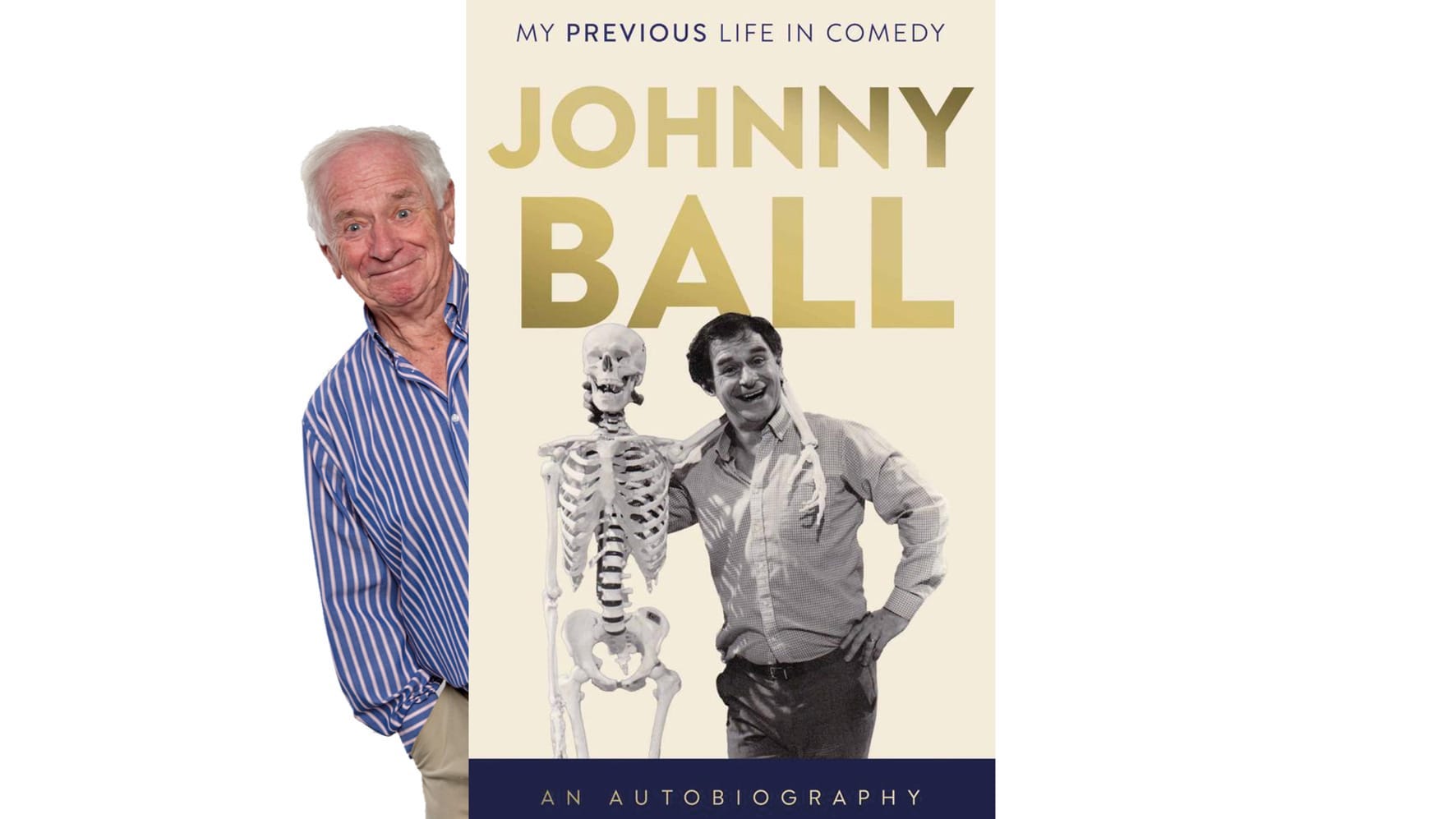
Hopefully, this short tour through my life has whetted your appetite to read the full-length version (with so many crazy stories and experiences) in Part One of my autobiography.
Johnny Ball’s My Previous Life In Comedy, is on sale right now. It will make great light and funny Christmas reading. Merry Christmas everyone! Part two of his autobiography, Johnny Ball - Stories that Must Be Told!, will be available to order from 1 January and on sale from 28 March 2026.