

This week, the Labour government published its social-cohesion strategy, Protecting What Matters: Towards a more confident, cohesive, and resilient United Kingdom.
Whatever the merits of the social-cohesion strategy – there are worrying potential issues around free speech, for example – the mere fact that social cohesion, belonging, community and more are major political issues reveals about contemporary British society. At Battle of Ideas North last Saturday in Manchester, we discussed these issues in the session Island of strangers: is Britain broken? with a panel of Dr Remi Adekoya, Ada Akpala, Lisa McKenzie and Graham Stringer MP.
You can listen to the audio by clicking below or as a podcast via Apple Podcasts, Spotify or your favourite podcast app.
We also admired the essay below by Academy of Ideas associate fellow Dolan Cummings when it was published last November. We’re delighted that Dolan has allowed us to republish it here. Dolan will be speaking at Living Freedom Summer School 2026 in London on 9-11 July. The summer school is open to anyone aged 18-30. Find out more here.
Strangers and strangers
Integration and belonging in liberal, modern Britain
Dolan Cummings
First published on L’esprit de l’escalier Substack, 14 November 2025
When Keir Starmer made his notorious and instantly-regretted ‘island of strangers’ speech in May this year, I happened to be reading Roger Scruton’s book, England: An Elegy (published in 2000). I was particularly struck by a passage in which Scruton described England, approvingly, ‘as a society of strangers’.
Clearly, he meant ‘strangers’ in a different sense from that intended by Starmer. He wasn’t referring to separate communities leading parallel lives, but celebrating the traditional aloofness of the English character. The way Englishmen and women, ‘keep each other at a distance, while acknowledging each other’s right to belong’. In contrast, Starmer was alluding to something like a crisis of belonging arising from advanced multiculturalism. Nevertheless, I think we can shed light on this issue by exploring the difference between these two senses of ‘stranger’.
In describing England as a society of strangers, Scruton was, in part, drawing attention to what English society was not: ‘Strangers do not live together by affection, by family sentiment, by swearing bonds of blood brotherhood in the manner of the Arabian tribes. They live together by law, convention and a silent appeal to precedent.’ In other words, English society is not clannish (and at least for the past couple of hundred years, neither is Scottish society). British society is not held together by particular obligations or kinship ties, but by implicit respect for anonymous fellow citizens – strangers.
Even when we talk about family values, we mean ‘the family’, not ‘my family’. It is not considered British to put your own family before the rule of law or reasonable concern for other people’s families. Neither is it British to offer bribes at an election, or to use public office for private gain. The fact that those who would be adversely affected by those things are strangers is no reason to disregard their interests.
The thing is, it is not particularly French or Danish to do those things either. The reason politicians so often tie themselves in knots trying to define ‘British values’ is that many of our most important values are not peculiarly British, even if they sometimes take a peculiarly British or English or Scottish or Welsh form. Fundamentally, they are civilised values. More specifically, we could say they are the values of Western liberal modernity, but that is not the property of any particular nation, or indeed of the West.
A home, not a creed
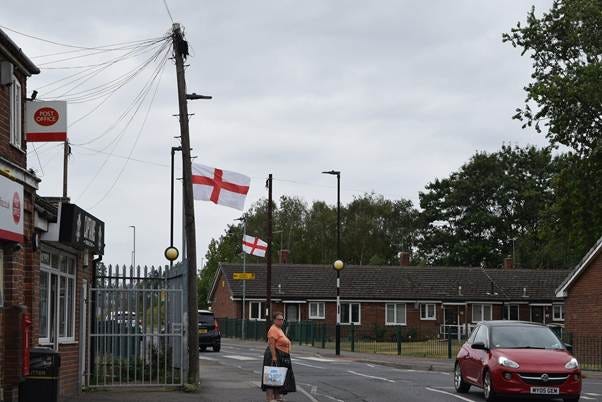
For that reason, when we speak about national belonging, we would do well to leave values to one side. This is in part what the Raise the Colours movement is doing. When people hang national flags from lampposts or paint them on roundabouts, they are not expressing their commitment to a set of values or ideas. They are claiming their streets and neighbourhoods as their home.
The movement has been condemned as divisive, and in a way it is, but not in the way critics suggest. As I read it, the purpose is not to exclude anyone in particular, so much as to insist that there is something here to be included in or excluded from. It is to say, ‘This is England’, ‘This is Britain’, ‘Isn’t it?’ If there is an edge to this, it is an implicit challenge: ‘Do you have a problem with that?’
(It should be noted that the same edge is there when businesses and public institutions display the ‘progress pride’ flag. And a similar ambiguity: does it mean ‘live and let live’, or signal conformity with a much more dubious ideology? Why does it so often feel like a challenge? Certainly, it seems unfair to treat rainbow flags as utterly unobjectionable while reading racist and even fascist motives into the flying of national flags.)
The Raise the Colours movement rejects the very idea – often expressed by critics – that it is reasonable for anyone to feel intimidated by the flag of the country they live in. Of course, there is a history of the flag being coopted by racists: ‘there ain’t no black in the Union Jack’. But today’s ‘flaggers’ are typically at pains to insist they have no problem with their non-white fellow Britons. The idea that national flags are racist is part of what they are protesting against. Above all, what they object to is the disdain for the flag shown by Britain’s (mostly white) cultural elite, the kinds of people who decry the flag as ‘racist’ when what they really mean is ‘ugh’.
That phrase, ‘fellow Britons’, is at the crux of the matter. We can argue about immigration – and about whether or how immigrants can be integrated – but the deeper question is whether British citizens have any special status at all. Those who fly the flags are proud to be British, English or Scottish, and of the rights and privileges that come as part of the package. Those who disdain them are uncomfortable with the idea that an accident of birth should confer rights on someone that are denied to anyone else. They prefer to talk about human rights, despite the impossibility of any nation state treating all human beings as citizens.
If citizenship is broached, it has to be distanced from ethnicity, and indeed it can be. While Britain does not technically have birthright citizenship (you need at least one legally settled parent), there is a commonsense, moral case that people who are born and brought up here belong, regardless of their ethnic background. It’s the ‘brought up’ part that is crucial, though, because it implies a slow, steady induction into a British way of life.
It does, at least, if the children of migrants grow up in neighbourhoods, attend schools and participate in forms of life that are recognisably British. If they learn to show that implicit respect for fellow citizens – although strangers in Scruton’s sense – and develop an understanding of and affection for the particular forms it takes in Britain. That is precisely what can no longer be taken for granted in significant pockets of the country. And that is why politicians find themselves trying to define Britishness, and floundering.
Again, we can grasp for ‘values’, preferably values that anyone can subscribe to. Modern, progressive values. But – aside from failing, laughably, to describe the character of immigrant communities – this only takes us further from any intuitive sense of what it is to love Britain as a home. Arch-reactionary Enoch Powell once said he would fight for Britain even if it had a communist government. He did not try to rationalise his patriotism.
Civilisational achievement and national character
So much for values. It can be just as unhelpful to speak in terms of culture, because that too often implies something like a mere preference. As if British people like fair play and the rule of law because that is our culture, while Iraqis, for example, prefer nepotism and corruption, because that is their culture. And that’s why British-style democracy has failed to take hold there. Well, maybe, but quite a lot of Iraqis would quite like fair play and the rule of law, given the chance, and the fact that those things cannot be successfully imposed through military occupation does not necessarily mean there are insurmountable cultural barriers.
It’s easy to forget that Britain’s national character is the product of centuries of history in particular conditions. When Scruton wrote about law, convention and precedent, what he was describing was not a cultural preference or national genius, but a civilisational achievement. That achievement cannot be taken for granted; it has to be nurtured and protected. That’s where we have gone badly wrong over the past 30 or 40 years.
The prevailing idea seems to have been that liberal civilisational norms are a function of modernity itself – almost in a blunt, chronological sense – and, indeed, fully realised only when they float free of the particular historical, cultural and religious inheritance from which they emerged. So, immigrants to a modern country like Britain – what Tony Blair bizarrely called ‘a young country’ – will naturally embrace ‘secular values’ even as they retain their own cultural identities.
When it comes to immigration policy, then, preserving the national character of the country is simply not a legitimate consideration. Indeed, to anyone shaped by what we might call ‘ideological anti-racism’ – which includes anyone educated in Britain over the past 20 or 30 years – ‘preserving the character of the country’ will sound like a dog whistle for ‘keeping the country white’. But colour is only the most superficial aspect of national character. Non-white Britons can and do share a deeper sense of Britishness. Even if you insist, as some do, on reserving Englishness as an ethnic identity, former Prime Minister Rishi Sunak is clearly British in a way Donald Trump, let alone Emmanuel Macron, is not. (Their national character, or lack of it, is distinctively American and French respectively.)
At the same time, to some degree, immigrants have always altered the character of the countries they adopt as home. That’s true even in countries like Britain and France that are emphatically not ‘nations of immigrants’, as the US to a limited extent is. Whole neighbourhoods can take on a non-native ethnic character – Chinatowns, Curry Miles, even ethnic districts without culinary attractions – without undermining the identity of the country as a whole. But there is surely a limit to this. In terms of sheer numbers, yes, but also the national imagination.
Certain particular waves of immigrants are part of Britain’s national story. The Windrush scandal was a scandal because everyone knew those affected had arrived legally and lived and worked in Britain for decades. Their children and grandchildren are unequivocally British. In fact, for historical reasons, British Jamaicans – like British Indians, for example – can have a kind of double belonging. Their Jamaicanness or Indianness can be part of their Britishness in a way that, say, a British German’s Germanness or a British Thai’s Thainess is not.
A place in the national mythology helps, but that’s not to say those without such a place cannot integrate as individuals. Indeed, a society of strangers in Scruton’s sense is much more accommodating than a clannish society of different kinds and degrees of belonging. A man’s funny name is his own business, after all, and no reason to exclude him from the arm’s-length community of mutual respect. Moreover, a society of strangers is also better able to accommodate those who do not belong at all. And it is a feature of all modern, liberal societies that, in addition to absorbing newcomers, they play host to others who have no particular desire to belong.
A digression on not belonging
It sounds very harsh to say anyone doesn’t belong. But when we talk about belonging to somewhere as much as in it, that’s also, necessarily, exclusive. If a sense of belonging doesn’t exclude anyone, then it doesn’t mean anything. The thing is, being excluded in this sense is not the end of the world.
Tourists, by definition, do not ‘belong’ in the deeper sense, but they are very welcome to visit. The same goes for business travellers, visiting academics and diplomats, foreign footballers and ballerinas. Nobody would say they belong in or to Britain, but nor do we want them cast into outer darkness. They are welcome to be here and to do their thing; that thing just doesn’t include voting in elections, using free health services or drawing a pension. I don’t suppose Mo Salah is offended by this.
Of course, there are grey areas. I didn’t include international students in that list, not because they are not welcome, but because we know that route is widely abused. The same goes for care workers and various other jobs where desperate demand has created easily abused loopholes. But the abuses are a superficial problem compared to the systemic one that we have an economic model that depends on importing large numbers of foreign workers.
When Britain was still part of the European Union, citizens of other EU states were almost archetypal ‘non-belonging residents’. These were people who, perfectly reasonably, took advantage of their right to live and work in Britain without seeking citizenship or (until Brexit came up) taking much of an interest in British domestic politics. And I doubt anyone voted for Brexit because they felt there were too many French bankers in London, let alone Austrian art professors in Edinburgh. The enlargement of the EU in 2004 and 2007 made immigration a much hotter issue because it allowed people from much poorer countries to work in Britain. This created something like a ‘non-belonging working class’.
If many people did object to the numbers of Poles and Romanians in places like eastern England, that reflected the different kinds of work they did. Bankers expect to compete in a global job market; those looking for a decent, working-class job in their home town generally do not. It also reflected the disproportionate effect of migration on smaller cities and towns.
More fundamentally, those waves of Poles and Romanians had no particular connection to Britain’s national story. Their newly-acquired right to work in Britain came with a new chapter in the story of the EU, and one not written with the British national interest in mind. Notoriously, the Labour government of the time massively underestimated the numbers of people who would show up. And – again, perfectly reasonably from their perspective – the great majority of those people showed up looking for work, not for a new home.
The normalisation of not belonging
This brings us back to the earlier ‘imported working class’ that was supposed to come to belong. Namely the Commonwealth immigrants who arrived from the West Indies and the Indian subcontinent between the 1950s and the 1970s. In many places, they did come to belong. I grew up in Glasgow in the 1980s with many Pakistani Muslim classmates whose families were well integrated into Scottish society. There are now millions of black and brown Britons who give credence to the happy story of successful multiculturalism so beloved of our cultural establishment. But, of course, that is not the whole story.
As early as 2001, the Cantle Report – commissioned in response to race riots in northern English towns – identified different communities living ‘parallel lives’. Especially in the post-industrial north of England, economic decline combined with official multiculturalism had seen various Asian and white communities pitted against one another in competition for resources and respect. There was little or no sense of belonging to a wider, national community.
Instead of Scruton’s society of strangers respecting one another as equals, certain areas became more like Starmer’s island of strangers. Or rather, a figurative archipelago, with each island occupied by an inward-looking community for whom those on the other islands were suspicious and hostile strangers. Given this analysis, the worst possible thing that could have happened was a continuing stream of immigration into these areas from places like Pakistan. Yet that is exactly what happened. The worst consequences are well documented.
How and why did it happen? Part of the answer has to be that even before the steady rise in immigration that began in the late 1990s, Britain’s political landscape was being transformed. Most significant was the peeling off of a distinct political class with little connection to or affection for other classes, and especially for the working class. That class governed Britain according to the set of assumptions described above: liberal social norms could be taken for granted as part of modernity; immigration policy should be guided purely by economic considerations.
Most importantly, this class did not see anything in the British way of life that was particularly worth anyone integrating into. Rather than seeing ‘non-belonging residency’ as the exception, they were happy to see more and more people, including those in established immigrant communities, lead parallel lives. They celebrated it as multiculturalism, not in the sense that people from different ethnic backgrounds can still belong, but effectively in the sense that there is nothing in particular to belong to. Or, as they would more likely put it, everyone belongs!
This is not how most British people think, even after decades of official multiculturalism. While some fear a resurgence of nativism, however, this is unlikely for the simple reason that there is no tradition of nativism in Britain. When liberal critics of Raise the Colours protest that all this flag-waving is positively un-British, they have a point. But only up to a point. Whether we warm to the flags movement or not, most British people – like most people in other liberal, modern societies – want a national home. Even as we keep our distance from our fellow citizens, we believe there is such a thing as a fellow citizen, and that not everyone belongs to that category. There is nothing strange about that.
* I’ve discussed Scruton’s book at more length in Three kinds of belonging.
† For more on ‘faith, flag and family’, see Liberal modernity and the three Fs.
Dolan Cummings is a writer and author. Read his Substack, L’esprit de l’escalier. He is also co-director of the Campaign for Freedom in Everyday Life.