

In so many ways, the issue of the distinction between sex and gender has become less toxic and one-sided than when trans ideology first took hold of institutions and inveigled its way into mainstream politics, with both the Conservatives and Labour embracing transgender inclusion as a core doctrine of equality. Stonewall’s ‘no debate’ era has been firmly prised open by the relentless work of so many grassroots activists, often at great personal cost, facing and fighting through cancel culture, smears and demonisation, winning not only court cases but also hearts and minds by using the disinfectant of sunlight to ensure that debating the issues has become the norm.
That means that attempts to smuggle in regressive, anti-women, pro-trans policies never go unchallenged. And we should all be indebted to the formidable movement that has been created in recent years by people who stepped up and led the way. Venice Allan is one such warrior, and her article below – about her years in the TERF trenches, and especially her battles within the Labour Party that now governs – gives an insightful taste of those early battles. Many thanks to The Frontline for allowing us to republish the piece.
Despite valiant victories, there remain some tough battles ahead, not least the dangerous Conversion Practices Bill, which the Labour government seems determined to push into law. Venice would be the first to acknowledge this is now a key fight in our lives: if it is allowed onto the statute books, it will undo so much that has been achieved. The ‘no debate’ mantra will become legally protected, and even debating gender identity in the family home could be criminalised. What’s more, gender identity could, for the first time, be given legal status.
Venice helped me organise one of the first briefings on the topic at the House of Lords, which in turn inspired a brilliant panel discussion on the issue at this year’s Battle of Ideas festival: Conversion Practices Bill: criminalising parents, teachers and priests? Take a look at the full debate at the end of this post. But in the meantime, over to Venice in her own words.
How I became a TERF
Venice Allan
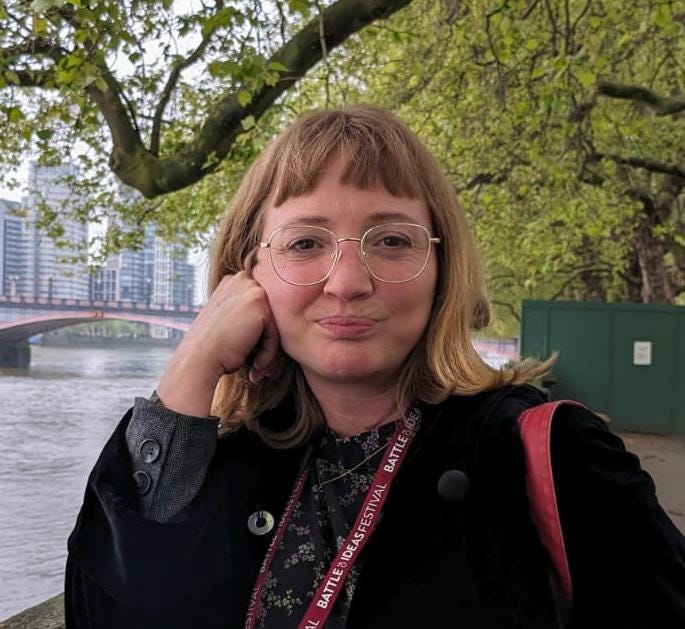
Sex, the biological kind, isn’t complicated; it’s binary, immutable and it matters. Yet somehow, like many other women and some men, I have spent nearly a decade arguing these basic facts.
When my brother first introduced me to the gender wars, I thought he was mad, but it didn’t take much for me to see that he had a point: Tara Hudson’s ‘7-inch surprise’ in a women’s prison just didn’t sound right.
So when a young woman introduced herself as a feminist at the pub, I provocatively replied that I was a TERF and was surprised when she told me that she was, too. She introduced me to Meghan Murphy and Magdalen Berns, whose videos, podcasts and articles I consumed over the next few months.
Men vandalising the Vancouver Women’s Library radicalised me. Weren’t these ‘honorary women’ supposed to respect us, not behave like violent, misogynistic thugs? But it wasn’t until I heard the then prime minister, Theresa May, promising to ‘streamline’ the Gender Recognition Act that I decided I needed to act. Lowering the age to obtain a gender recognition certificate to 16, making nonbinary a legal category and removing the requirement of a diagnosis of gender dysphoria all seemed like a terrible idea.
The ‘Left’ refused to listen
Embarrassingly, I was then a ‘Corbynista’ and thought that all I needed to do was explain it to Jeremy who would lead the Left to support women and children against this stupid, right-wing law change. How naïve I was!
My new friend and I decided to put on an event at our local library, with speakers for and against the proposed reforms. I’d hoped that my Momentum group would host the discussion, but they wouldn’t even let me invite my comrades. However, the two lovely women who managed the library let us book it anyway, and we somehow got two speakers from Stonewall to debate Julia Long and Miranda Yardley.
The debate they wouldn’t let us hold
Five days before the event, Bex Stinson, the Stonewall trans inclusion officer, told us that he had been invited on a last-minute hiking trip and had to cancel, along with his lesbian colleague. He later publicly denied ever even agreeing to speak, forcing me to publish our emails to prove that he was lying about more than just his sex.
Disappointed, we persevered. It didn’t need to be a debate, as Julia pointed out, Conservatives don’t give counterpoint arguments at Labour conference. That is when the harassment of the venue began. Started by anarchist groups, Sisters Uncut and Class War, and followed by LGBT Lewisham, Goldsmiths University, at least one Labour MP and many Labour councillors, overwhelmed the librarians with complaints. The night before the event, they said they didn’t have the ‘risk appetite’ to go ahead.
So we did, for the first time, what we have been doing ever since: gathered online and found a new venue. Not wanting to invite the same hostility, we decided to find a meeting point to direct attendees from. Nearby Speakers’ Corner felt symbolic, so we directed the growing number of women, made curious by the cancellation, to meet us there.
The night that changed my life
On the evening of Wednesday 13 September 2017, we were met by a group of trans activists, my first encounter with such people. They shouted chants and held signs, not recognising the irony of calling for ‘no debate’ at that iconic location of free speech.
We had written the address of the venue on little scraps of paper and told women to make their own way to the venue to avoid being followed. What happened next is well documented. Some women didn’t want to leave straight away and stayed in Hyde Park to observe the protesters. Sixty-year-old Maria Maclachlan was attacked by three strapping young men in lipstick. She and her camera were smashed to the ground, and the police there did nothing.
I left with my mother and a couple of friends. We hailed a black cab and, in true movie style, told him to ‘just drive’ to lose the TRAs. Not all the attendees took such an expensive precaution, and the venue was discovered and the protest continued outside. If you watch the videos of the speeches from that night, you can hear the protesters chanting in the background.
In the morning, our phones were ringing off the hook. My friend didn’t want to speak to the media, so I went from being a Facebook loudmouth to being interviewed by national and international press. We received so many threats online that we compiled them into a video, set to Carole King’s version of ‘(You Make Me Feel Like) A Natural Woman’.
My life changed that night. What was meant to be a small, local event went viral. Only one of the three men who attacked Maria was eventually caught, convicted of battery and given a lenient, suspended sentence, while Maria was denied compensation for being unable to call him ‘she’ in court. I was later suspended from the Labour Party and taken to court by a trans activist myself.
Why I’m still fighting
We’ve come a long way since then. As an ever-expanding grassroots movement, we have stopped self-ID, removed most men from women’s prisons, shut down GIDS and forced the state to recognise sex in the Equality Act. We also helped bring in new guidelines to stop forcing victims having to use preferred pronouns in court.
We now have JK Rowling and apparently even the King is a TERF. But although most of the public are onside, trans insanity continues, its latest incarnation a ban on ‘conversion practices’ which would make telling a girl that she’s not a boy a criminal offence, punishable by up to five years in jail. Under-regulated adult gender clinics are still castrating vulnerable youngsters on the NHS and we women are still in court defending our sex and free speech, at great cost. I fear it will never end…
Venice Allan is a jewellery designer and maker at Prangsta Costumiers who volunteers for Baroness Claire Fox in the House of Lords and at the Battle of Ideas festival. She has two grown-up sons and a cat. Find her on X: @roseveniceallan.
This article is reproduced from The Frontline – subscribe here.
Susan Dalgety and Lucy Hunter Blackburn launched The Frontline on Substack in May 2025 to build on their experience of editing the best-selling The Women Who Wouldn’t Wheesht. The Frontline is a bold, unapologetic publication amplifying the voices of women which are all too often excluded by mainstream political and state-funded civil society organisations. It provides space for women to reflect on their experience of being a woman in the first half of the twenty-first century.
The experiences shared are from around the world, from women of all ages, covering anything from raising a child in a warzone to the value of sport for women, from experience in politics and campaigning to personal struggles with caring for vulnerable relatives. One aim is to build an archive of first-hand accounts of women’s struggles for their rights, from the last century to the present. The publication is without a paywall, so that it is accessible to all women, but relies on the generosity of paid subscribers to make sure none of contributors is asked to work for free.
The women’s movement has always used the printed word to build communities, share stories and ideas and advance our rights. The Frontline follows in the footsteps of all those who have used stories to spread the message of women’s liberation. The form may be digital but the values are timeless.
I have admired Venice Allen on Twitter for years! She is so inspiring 😎
The distinction between sex and gender is clear, unambiguous.
Sex is a term used in biology to denote male and female the two members of a species which reproduce and propagate the species.
Gender is a term used in language to classify nouns and ensure correct syntax. In some European languages there are two or three genders, masculine, feminine, neuter. In other languages there may be more associated with what object or use the noun describes.
That’s it. Sex has no use in language, gender has no use in biology - it is just a political and ideological catch-phrase, an empty signifier.