

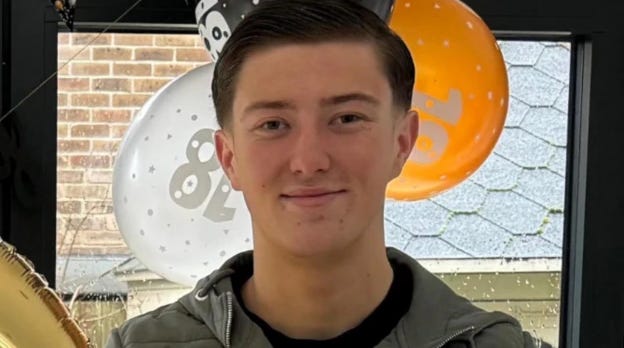
‘We’ve just been attacked racially by some white person.’ Vickrum Digwa’s brother instinctively knew which buttons to press to mobilise the British state. The ideology behind the treatment of Henry Nowak, and sadly now a growing list of state failure in the name of anti-racism, is – of course - a political one.
It is now widely accepted that police and local authorities failed to pursue the participants in grooming gangs in part because of fears over community tensions and accusations of racism. Yet the comparison with Nowak’s case becomes clearest when viewed through individual examples. A father arrested twice for trying to rescue his 14-year-old daughter from a gang of Asian men. A Labour councillor dismissing victims as ‘poor white trash’. Girls, plied with alcohol and drugs by their abusers, routinely picked up for drunken and disorderly behaviour. Time and again, the machinery of the state seemed more willing to suspect the victims than their assailants.
The most uncomfortable thing about the police footage of Henry Nowak’s arrest is the apparent disregard for his life. ‘I don’t think you have, mate’, an officer replies after Henry tells him he has been stabbed. It reflects the immediate profiling of a likely drunk, white racist who, in the eyes of the police, had abused a respectable Sikh family and therefore was not worth listening to. You can see the prejudice of the police operating in real time.
Of course, the officers in question have not yet been dismissed, pending an investigation. The Independent Office of Police Conduct says they are currently being treated solely as witnesses. In recent years, it seems that the most egregious crime an officer can commit is not the facilitation of the death of an 18-year-old university student, but making racist remarks. For example, who could forget the BBC’s brave, courageous and desperately needed Panorama film in which an officer was plied with nine pints of Guinness before making off-colour remarks about Arabs and Algerians being the ‘worst’ criminals to deal with?
The ideas of ‘unconscious bias’, ‘white privilege’ and ‘systemic racism’ have been drilled into a generation of workers thanks to the EDI-ification of society. After the Manchester Arena bombing, in which 22 people were murdered, security personnel admitted they had not approached the suspicious perpetrator because ‘I was scared of being wrong and being branded a racist if I got it wrong and would have got into trouble’. Risks identified by teachers regarding Axel Rudakubana, who later murdered three young girls in Southport, reportedly went unreported because of concerns about stereotyping a ‘black boy with a knife’. Valdo Calocane, who killed three people in Nottingham, was discharged from care amid concerns about the over-representation of young black men in detention.
Of course, pleas to ‘not politicise’ these tragedies – driven by an ideology that nobody voted for – are selectively applied dependent on the victim. The murder of George Floyd, thousands of miles away, prompted calls for political reform here in the UK. The House of Commons and the House of Lords held a minute’s silence for Floyd – but that seems unlikely for Nowak. The police shooting of career criminal Chris Kaba sparked calls for justice, institutional reform and the vilification of firearms officers by Sadiq Khan, Diane Abbott and Jeremy Corbyn. Yet when the full facts were laid out at trial, the officer in question was acquitted by a jury in just three hours.
Going by the testimony heard at the Nottingham Inquiry – where bereaved families said institutions closed ‘ranks to try to keep us quiet’ – there is a fair chance that Henry Nowak’s parents could face similar pressures as they seek answers about their son’s death. How Henry’s parents grieve, and what they choose to do, is entirely up to them. Yet the Nottingham Inquiry, and the determination of the victims’ families, has demonstrated the importance of persistently challenging rotting public bodies and demanding transparency. As Emma Webber – mother of one of Calocane’s victims, Barnaby Webber – told the hearing: ‘We have faced evasion, self-protection, avoidance and downright lies so many times.’ That observation could apply to every tragedy mentioned above. Depoliticising these events only serves the government and the institutions that fail us.
Why was Henry Nowak’s killer not arrested at the time? Why did officers search Henry’s phone for evidence of racist abuse? While Digwa’s father and brother have been charged with weapons offences, why have they not been charged as accessories after the fact? (His mother awaits sentencing after being convicted of hiding the murder weapon.) As Dr Sanjoy Kumar told the Nottingham Inquiry, ‘there wasn’t a single institution involved in our case that didn’t fail’.
Until those questions – and others – are answered, we must not ‘move on’. Accountability is not hatred. Perhaps Farage is correct and on this – ‘we should be angry’. Because if a young man’s death, a catalogue of institutional failures, and a political ideology that repeatedly seems to blind public bodies to reality, cannot justify our anger, then what can?

The stream of senior Police Officers and politicians insisting that there is no 2 tier policing is gaslighting on an epic scale. A bit of history of how we got here (from someone who served in the job for 26 years). "Diversity Training" was introduced in the late 1990s, the trigger for it was the Stephen Lawrence murder but IIRC the training was introduced before McPherson dropped his dismal report (it's almost like the outcome was pre-ordained!). In my force, the first we new when an "all hands" meeting was announced where the Chief Constable was going to address us. He very clearly told us that we would be getting some new training around something called "Diversity" and that if we didn't attend or failed to buy into it, then we were expected to resign(!?!?). So we turned up to this mandatory training. Bear in mind that we were now used to "experts" with zero experience in policing (or life generally, as far as I could tell) rocking up clutching the latest fashionable academic thesis and telling us how we ought to be doing our job, but this was next level stuff. Each group was arranged in a large semi-circle around the "instructor" who once again had ZERO experience in policing. It started out harmlessly enough, but was very much teaching granny to suck eggs, it was all around how if the force was hosting a community event, we could cause offence to some sections of the community if we served ham sandwiches with the buffet etc etc. None of us hosted these type of events (that was always the office based senior officers) but we ALL knew this stuff because we were the ones actually interacting with the community day-in, day-out. Having set the scene, the "instructor" used these examples to establish the principle that we need to be treating minority groups differently, not equally, as they have different needs and experiences and failing to treat them differently lead to injustices, unfairness and grievance. Anyone who pointed out that this principle conflicted with the principle of "Policing without fear or favour" and "Everyone equal before the law" was brutally shot down "Oh so you are in favour of serving up food that goes against the deeply held religious convictions of some people? This level of ignorance is why there are so many problems with policing". From there, the principle of treating groups differently was extended out to more dubious claims, but challenges were brutally put down. At the end of the training each delegate in turn was compelled to stand up a give an expression of how they would be treating minorities going forwards, it was the most sinister and unsettling experience of my entire service. Obviously, the best course of action was to nod along then just carrying on policing the way we had been. But management had other ideas. Until then promotion and appointment to specialist units had been done via looking at the candidates tracking record to short-list them, then going through a competitive interview to really tease out your knowledge and suitability for the role. That stopped overnight, experience and knowledge was dropped from the interview process and the interviews were lead by HR who tested your knowledge of "Diversity" and wanted examples of when you had challenged discrimination amongst colleagues. If you couldn't give any examples, you simply didn't get the job. So, the troops gamed the system by circulating sample answers to the diversity questions. Management realized what was happening and responded by making "challenging discrimination by colleagues" one of the targets in your annual PDR, you could no longer bluff it, in order to get promotion or a specialist role you had to have actually challenged a colleague and document it in your PDR, even better if you grassed them up to a supervisor! So, the overall effect was to create an environment of complete distrust within the police service - the esprit de corps that was essential to policing was destroyed overnight. The problem was that, contrary to what management thought, the troops weren't a seething cauldron of hate and racism, so the more ambitious members of staff who wanted to get on, ended up grassing up colleagues for the most trivial and benign infractions you could think of, that really made the air of distrust internally visible to management. Management's response? Well, rather than have officers turning on each other, they set officers on the general public. Those PDRs were amended to make it an ACTIVE KPI that you tackle any form of discrimination by the public - the Police are actively incentivized to go Diversity-maxxing. The culture of total distrust within the police service was now extended to the whole of society. Alongside this was the increase in Diversity indoctrination via ever more frequent mandatory Diversity Training. Internally, what can only be described as a "DEI Inquisition" was set up so that any officer who was even suspected of not being fully on-board with the DEI agenda; you would face intense challenges by snr officers and HR, you would have to attend remediation DEI training etc. Of course, the re-tooled promotion boards meant that only the DEI True Believers could get to the top jobs. The staff that were the best coppers but didn't buy the DEI guff stayed in the lower ranks and were often moved to the most unrewarding roles. All the DEI nonsense that has been inflicted on the public was first road-tested and implemented in the Police service, it really is the DEI laboratory. I share the same anger as everyone else about events surround Henry Nowak's murder (to be clear; the officers involved screwed up big time, likely know it, but can't fully understand why they screwed up so badly) but it's worth bearing in mind that 10s of thousand of great coppers share the same anger too. I think we are to some extent surprised that something inevitable like the Nowak tragedy took so long.