

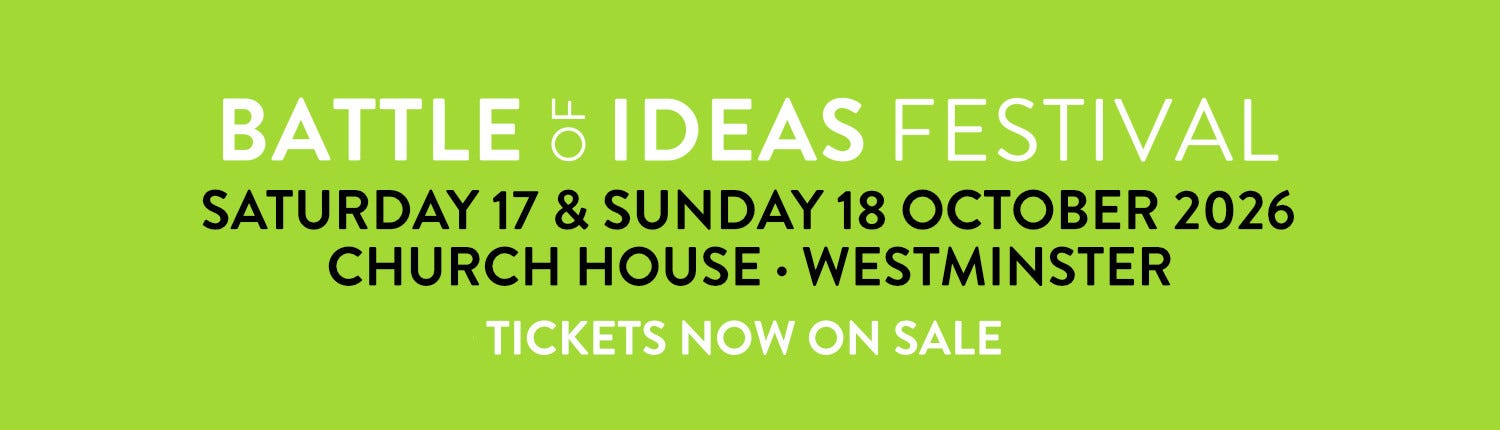
Battle of Ideas festival is the UK’s premier annual festival of debate on the biggest issues of our times. And wow, there are a lot of issues to discuss. In the wake of revelations about the police’s inhumane treatment of stabbing victim Henry Nowak, which has shocked the nation and had international coverage, those at the heart of the British government attempted to tone-police the way it was discussed in public. Use of the phrase ‘pure, cold rage’ was dubbed incitement, the accurate debate about ‘two-tier policing’ was condemned as divisive. Policy discussion about whether a faux anti-racism, imbibed by every police force via EDI training, was itself described as stirring up racial tensions. The mood of ‘you can’t say that’ is too often a feature of social and cultural exchanges. Not, however, at the Battle of Ideas festival.
Because, unlike so many other festivals, the Battle of Ideas has the motto Free Speech Allowed. It’s not just a talking shop for the great and the good. Attendees are as much a part of our festival as the speakers. Indeed, we think that the audience is the festival. From the ongoing crises in British politics and society to tectonic shifts in world affairs, there is a lot to debate and think about.
The UK has plenty of problems to face at the moment, from a flatlining economy to frequent controversies about immigration, social cohesion and the lack of consensus about the past, the present and the future. Instead, we are offered endless shenanigans about who should lead the government, while the various contenders offer little or nothing in the way of an inspiring vision of the future.
Worse, the internal civil war in the Labour Party has imposed an unnecessary by-election on one local area, local voters reduced to being mere devices to affect a prime ministerial job swap, with no discernible big ideas to merit such manoeuvres. As one X poster noted wryly about professional Northerner Andy Burnham: ‘He’s Keir Starmer with more emotion, and a Paul Smith t-shirt.’ Of course, the rise of Reform and the Greens indicate an ever-growing disenchantment with politics as usual. Whether these parties are fit for purpose will no doubt be hotly contested at the festival.
Whoever is crowned Labour prime minister, one trend that is guaranteed to continue is the tendency to substitute ever-greater regulation and prohibition in place of social and economic progress. Attacks on free speech are so common in the UK that they’ve drawn international attention and condemnation. But at every level, right down to the minutiae of everyday life, politicians seem keen to ban things, from social media for under-16s to smoking cigarettes for anyone born after 2009. Far from living in a ‘free market’ society, government wants to regulate the price of energy, rent and even food. All this while the traditional institutions of the state, from policing to healthcare and beyond, increasingly let us down. Why is this happening and how can we fix it?
Meanwhile, geopolitics is in flux and feels dangerously out of control. Conflicts in Ukraine, Gaza and Lebanon have now been joined by the war in Iran. The choking of the Strait of Hormuz has thrown the world economy into turmoil – hot on the heels of events around Venezuela and Greenland. America – like Russia in Ukraine – is discovering that overwhelming firepower can be made meaningless by drones and other cheap weapons that give weaker countries the capability to stay in the fight. What does that mean for the future of warfare?
The ‘Western alliance’ has never been under such strain since the Second World War. Is this just the impulsiveness of Donald Trump or has he simply brought longstanding tensions into the open? And is the UK even fit to defend itself, let alone intervene more broadly, when one of Labour’s own grandees, Lord George Robertson, described the stasis on defence spending and security as an example of ‘corrosive complacency’. Hardly reassuring.
The world economy was creaking even before events in Iran. The UK government is not alone in facing an enormous debt burden – America, France, Italy and Japan are in the same boat. Are we facing a global sovereign debt crisis? Artificial intelligence (AI) has taken off, but does the new technology offer the economic benefits of industrial revolutions of the past or is it a threat to our futures – and will we even have the energy supplies to power it? What will be the impacts in wider society, from education to culture?
With all this going on, the need for open and honest debate has never been greater. Yet many people seem stuck in intellectual silos and political tribes, unable to engage with those who disagree with them. Social divides – between young and old, men and women – seem to be entrenched. The role of the media – whether it is the mainstream broadcasters and outlets, the rising tide of ‘new’ media or the flurry of information and debate on X, TikTok and Facebook and the rest – needs some critical interrogation. Do we need to relearn the fine art of disagreement?
We’ll be discussing all this and much more over the course of the festival weekend in London and in our various events before and after, taking place across the UK and Europe. Come along, listen to the arguments and have your say. If you’re interested in what is going on in the world, have an opinion and want to challenge others – and be challenged yourself – then Battle of Ideas festival is a fantastic experience. Join us on 17 & 18 October at Church House in Westminster. There is nothing like being there.
