

As ever, discussing the arts will be a central feature of the Battle of Ideas festival on Saturday 17 and Sunday 18 October at Church House, Westminster. Among the debates are From boycotts to renaissance: threats and opportunities in the arts, Podcast Extra: Arts First: myth, religion and national identity, Once upon a time: children’s literature and the culture wars, When activism meets the arts and Benjamin Britten, 50 years on: still the nation’s composer?
Tickets for the festival are still available via the Battle of Ideas festival website, with big discounts for students and concesssions, and free tickets for school pupils.
Below is an essay by one of this year’s speakers, Professor Ian Pace, adapted from a speech he delivered at The Exeter Union last month. It is an intelligent and learned riposte to the idea that we should reject art because its creator(s) have behaved badly or have the ‘wrong’ views.
Ian is one of almost 400 speakers at the festival, all bringing considered thought to an enormous range of issues. If you want serious, well-informed debate, the Battle of Ideas festival is the place to find it.
Claire
INTRODUCTION
On Friday 25 September, I spoke at The Exeter Union in support of the motion ‘This House Would Separate Art from the Artist’, alongside Denise Fahmy of Freedom in the Arts. The two opponents were Rachel Krengel and Lucas Chapman, the latter vice-president of the Union. The opponents won the debate by a considerable margin – a poll is taken at the beginning and then another at the end, and the key element is how many votes change sides – though it was possible to vote ‘undecided’ at the beginning but not at the end. I had mixed feelings about the debate: too little actual art was discussed, exemplifying the problem I was trying to diagnose, and there did not seem to be much interest in it. During audience questions, one person brought up the subject of JK Rowling, leading to angry denunciations which had an almost Maoist quality to them. This was when I knew the debate was lost for our side.
I came away from the debate disappointed to find how tenacious a particular conception of art remains: the artwork is essentially an expression of its maker, a window onto a personality or moral character, and therefore something whose value and meaning can largely be determined by what we know about the person who produced it. This seems all the more remarkable after well over a century of challenges to such assumptions: Mallarmé and Wilde, Aestheticism and Decadence, Proust’s attack on Sainte-Beuve, the Russian Formalists, IA Richards and the New Critics, Wimsatt and Beardsley’s ‘intentional fallacy’, structuralism and poststructuralism, Barthes’s ‘death of the author’, and a huge body of modernist and experimental artistic practice. All of these movements or arguments are somewhat different from the others, and I would certainly not subscribe without qualification to all of them. But collectively they have served to render very problematic a view of art as self-expression or biography in another medium.
One exchange during the cross-examination crystallised the problem for me. A speaker opposing the motion claimed that nobody buys a book without knowing who its author is. I asked about works such as Beowulf, Sir Gawain and the Green Knight and Pearl; about the uncertainty over whether the Iliad and Odyssey are the work of a single identifiable individual; and, more simply, about folk tales or folk music. The reply was, in effect, that it would be wonderful if we knew who had originally written the folk tale or song. But this seems to me a fundamental category error. A folk song or tale does not really have a single author in anything like the modern sense of the concept: songs and tales are and have been transmitted, modified, combined with others and collectively reshaped across generations and have moved between geographically distant cultures. To identify an individual author is to impose precisely the model of authorship that such objects call most fundamentally into question.
More broadly, I find surprising and dispiriting the persistence of what might be categorised as a neo-Victorian moral-biographical model of criticism. The irony is that Aestheticism – in the work of Walter Pater, Oscar Wilde and others – issued a direct challenge to this conservative moralisation of art in the nineteenth century itself, insisting that artistic value could not be reduced to moral instruction or to the character of the artist.
The argument here connects with several issues about which I have written previously: the distinction between representations of reality and reality itself in my essays on cultural realism; the history and value of formalist approaches to art; and, more recently, the question of how we distinguish judgments of works, performances and arguments from judgments of persons – and the extent to which some mechanisms of judgment operate across these different domains. What follows is an expanded version of my Exeter statement, developing some of those connections further.
FURTHER READING
The Problem with Cultural Realism, Part 1 and Part 2 (2025).
The Persecution of the Soviet “Formalists”, Part 1 and Part 2 (2025).
Why Cancel Tchaikovsky? (2022)
How could anyone serious think that Wagner’s politics haven’t been discussed enough? (2025)
The Art of Judgment Part 1 and Part 2 (2026).
This House Would Separate Art from the Artist
Debate at The Exeter Union, 25 September 2026
Statement in support of the motion by Professor Ian Pace
‘Separate the art from the artist’ can sound as though we are being asked to build a wall between the two. I don’t mean that; I do think we should know as much as we can about artists, including the unpleasant things. But we should also ask what follows from that knowledge – and what does not. Keep distinct four things: the artist’s conduct; the artist’s persona; the work’s moral or political character; and the work’s aesthetic value. Connections between them may be strong, but they have to be demonstrated rather than assumed. To separate things maintains distinctions, but does not deny the continuing presence of connections.
The danger today is not that we know too little about artists, but that we sometimes know too much. As a result, the work often disappears behind the biography, or at best becomes a footnote to it.
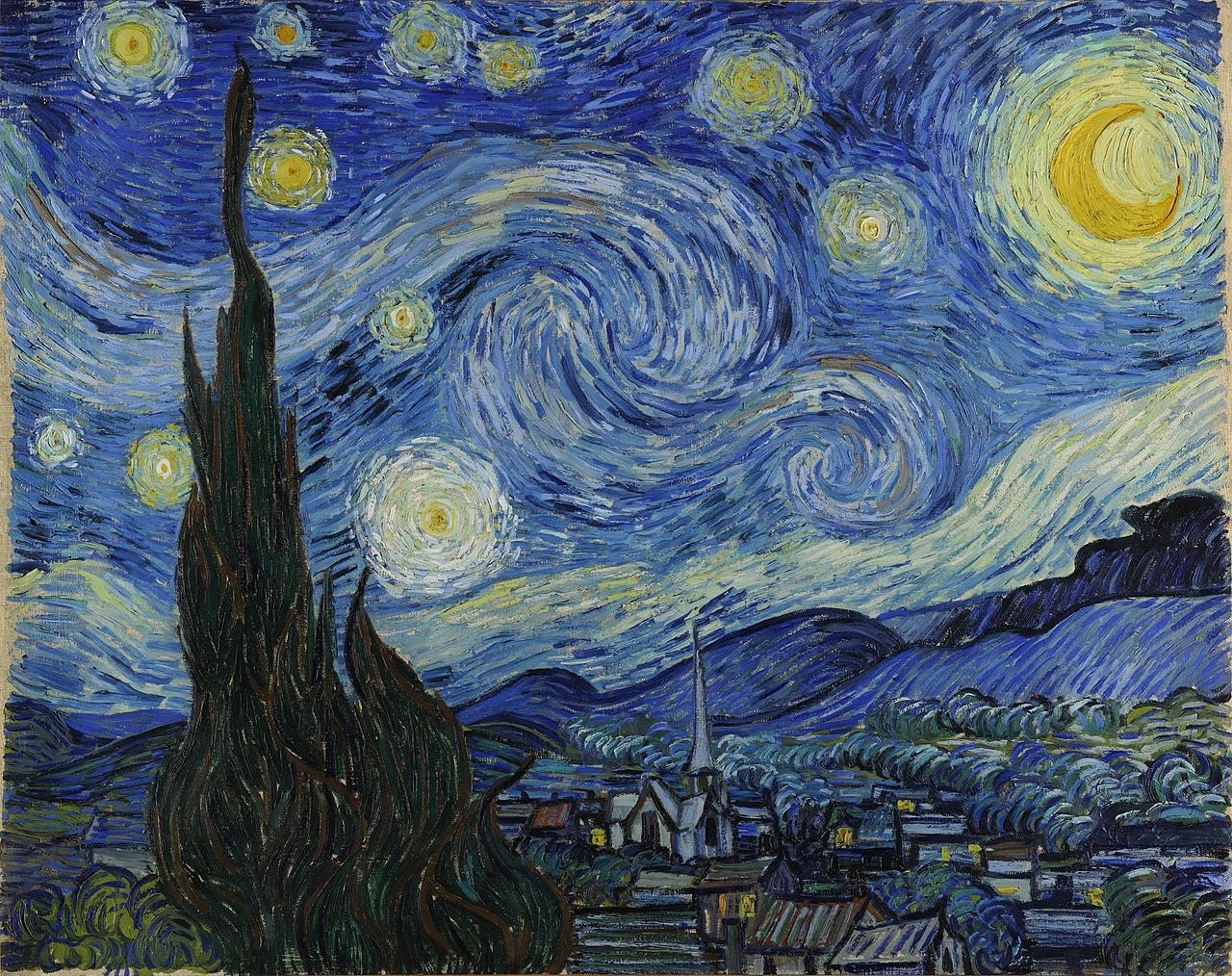
That is striking almost 60 years after Roland Barthes declared ‘the death of the author’. He complained that the image of literature in ‘contemporary culture’ was ‘tyrannically centred on the author, his person, his history, his tastes, his passions’. Baudelaire’s work was explained through ‘the failure of the man Baudelaire’, Van Gogh’s through his madness, Chaikovsky’s through his ‘vice’. But Barthes believed the author had ‘died’ because writing was always constructed from pre-existing languages, codes and quotations, rather than having a single sovereign consciousness as its origin; the meaning of a text came instead at the point of reading so that ‘the birth of the reader must be ransomed by the death of the Author’.
Barthes himself saw Stéphane Mallarmé as ‘doubtless the first’ in France ‘to see and foresee in its full extent the necessity of substituting language itself for the man who hitherto was supposed to own it’. This was not an isolated move on the part of Mallarmé: Russian Formalists shifted their focus away from biography towards the role of literary devices and narrative processes; structuralists explored signs, systems and codes obsessively; while poststructuralists such as Jacques Derrida further challenged and unsettled the very nature of meaning, let alone the notion that it could be securely traced back to a single authorial origin. One need not accept all of these views to recognise how thoroughly a whole tradition of criticism had rendered problematic a simple equation of work with maker. Today, the author has returned – not so much as sovereign figure determining meaning as one put on trial, the outcome of which becomes the determinant.
Modern celebrity culture has intensified this focus on the person. The sociologist Chris Rojek argues that celebrity involves a split between a private self and a staged public face. Cary Grant joked that even he would like to be Cary Grant. Drawing upon Donald Horton and Richard Wohl’s concept of parasocial interaction, Rojek shows how media enables audiences to feel a false sense of intimacy with people who remain strangers. Then, when a celebrity scandal erupts, some members of the public imagine that in the process they have finally gained access to the ‘real’ person beneath the public persona. But familiarity with a persona, or with stories about the private person, can both be mistaken for actual knowledge of a person – and judgment of the person can then determine judgment of the work.
Biography can exert a similar hold on audiences. Reading about a life frequently delivers sex, money, betrayal and scandal and, as a result, biographers can appeal to readers who would never buy books featuring specialist criticism of harmony, prosody or pictorial composition. James Shapiro observes that biographies can even act as a substitute for the works they were meant to illuminate. Once we know the life, we may think that this has explained the meaning of the art. But this is a fundamental error. It is much easier to tell an audience whom somebody slept with than to explain to them how a poem, score or painting actually works. Sometimes biography is not deeper criticism, but actually an escape from the greater difficulty of undertaking criticism at all.
Marcel Proust made essentially this objection to the critic Charles-Augustin Sainte-Beuve. Sainte-Beuve had sought to interpret writers’ works through study of their lives, habits, friendships and social personalities. For Proust, this confused the social and creative selves, and the method had failed its most obvious test: Sainte-Beuve fundamentally misjudged Stendhal, Balzac, Baudelaire, Flaubert and Gérard de Nerval. Proust instead wrote that a book is produced by ‘a self other than that which we display in our habits, in company, in our vices’. The person who exists in a social arena is not the same as the person who creates the work.
Shakespeare is a useful case, because the lack of personal or confessional material is almost a blessing. There are no diaries explaining Hamlet, nor interviews about King Lear. Shapiro shows that biographical reading of literature is historically contingent: it emerged in the late eighteenth century with Edmond Malone, who assumed that Shakespeare could only write convincingly about what he had lived, not what he had read, heard, borrowed or imagined. The Romantics took this a stage further, so that gaps in Shakespeare’s known experience could become used as evidence against his authorship. Shapiro says that this diminishes what makes Shakespeare exceptional: his imagination.
Shakespeare did not have to be a king to create Lear, to murder anyone to create Macbeth, or be a young woman to create Rosalind. Nor did Quentin Tarantino need personal experience of murderous bank robbers in order to make Reservoir Dogs. He drew upon inherited cinematic genres, character and plot archetypes, visual languages and other products of cinematic history, transforming them into something new. Anthony Hopkins’s performance of Hannibal Lecter did not demonstrate he had an appetite for human brains. We see the absurdity with actors, yet criticism makes the same mistake in a subtler way with characters or personae.
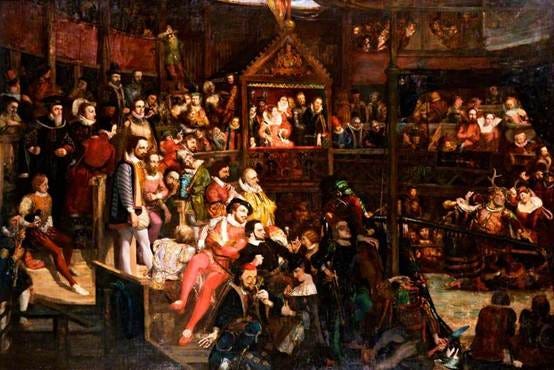
David Scott, Queen Elizabeth Viewing the Performance of ‘The Merry Wives of Windsor’ at the Globe Theatre (1840). 185 × 275 cm, oil on canvas. Victoria and Albert Museum, London.
The biographical model is even more problematic in the context of collaborative artistic work. Whose inner life is represented by The Godfather – Francis Ford Coppola’s, Mario Puzo’s, Marlon Brando’s or Nino Rota’s? A Beatles record involves not merely Lennon or McCartney, but the other Beatles, George Martin, engineers and inherited musical traditions. Sometimes ‘What does this work reveal about the artist?’ first has to answer ‘which artist?’ Rejecting a collaborative work because of one contributor means rejecting the work of the others as well.
These examples point to a much more significant consideration. Art is not simply evidence that has been left behind by an artist. On the contrary, creating art allows human beings to escape the confines of what they already are or have already experienced. The Greek word poiesis means making. Artists take inherited materials – language, genres, tonal systems, myths, images, conventions – and make from them something new. Their work may bear traces of the world in which it was created and of the artist who made it, but a trace is not the same thing as an identity.
In ‘Tradition and the Individual Talent’, TS Eliot distinguished ‘the man who suffers’ from ‘the mind which creates’, in which feelings, phrases and images combine into ‘a new compound’. Susan Sontag made the larger point simply in her essay ‘On Style’: ‘Art is not only about something; it is something.’
So criticism has to ask not only ‘Where did this come from?’ but equally ‘What has been made?’ Knowing that Caravaggio killed a man does not tell us about the role of light, gesture and space in The Beheading of St John the Baptist. Nor does biography explain a cadence or rhythmic pattern, axial space in architecture, or choreographic counterpoint in dance. At some point, we have to pay proper, concentrated attention to the work.
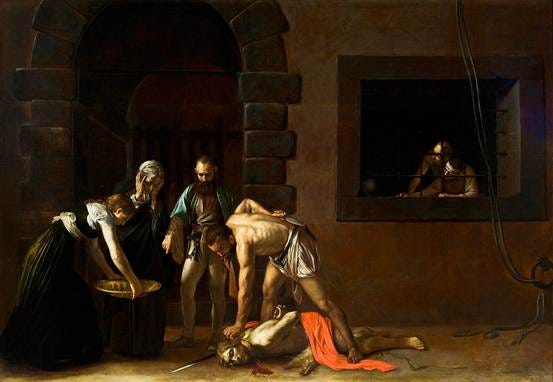
Michelangelo Merisi da Caravaggio, The Beheading of St John the Baptist (c. 1608). 360 x 520 cm, oil on canvas. Oratory of St John the Baptist, St John’s Co-Cathedral, Valletta.
Nor does the maker’s own intention settle what it is that has been made. WK Wimsatt and Monroe C Beardsley called that assumption ‘the intentional fallacy’. Their argument was part of a wider critical turn, anticipated by IA Richards’s experiments in anonymous practical criticism and developed by the American New Critics, who sought to judge works independently of the author’s biography or prestige. This would, at least in principle, bracket out consideration of gender, ethnicity or social identity. Wimsatt and Beardsley’s stronger claim – that intention is neither possible nor desirable as a critical standard – has been hotly contested since they first made it. But a more modest argument has survived: that the maker of a work does not have permanent sovereignty over its possible meanings. Once released, the work becomes publicly circulated, and encounters performance, interpretation and reception, which the maker cannot entirely control. A work encountered two centuries after its creation, under political or cultural circumstances which could never have been imagined by the artist, can acquire new meanings that no statement or knowledge of original intention could exhaust.
Separating the work from its maker does not mean treating it as morally innocent - quite the reverse. Oscar Wilde wrote in the Preface to The Picture of Dorian Gray that ‘vice and virtue are to the artist materials for an art’. Wilde’s point was not that morality is absent from art, but that moral material is transformed by the ways in which the artist uses the medium. From Baudelaire to Huysmans, Wilde and Rachilde, Decadent artists made work out of corruption, artificiality and moral unease. In 1895, Edward Carson read passages from Dorian Gray when cross-examining Wilde about his own morality: the work was literally turned into evidence against its maker.
A culture incapable of distinguishing depiction from endorsement would lose not merely Decadence, but tragedy, satire, horror, the grotesque – all huge realms of artistic experience. Art must be allowed to go where respectable conduct cannot. Pier Paolo Pasolini’s film Salò pushes this possibility to an extreme. In all such cases, the moral character of the material does not predetermine the aesthetic – or even the moral – significance of what is made from it.
I am not suggesting biography is irrelevant. Some artists’ life, public persona and work were quite deliberately entangled, though this did not make them identical. Lord Byron is an obvious case: his travels around Europe fed so deeply into Childe Harold’s Pilgrimage, while the public figure of ‘Byron’ shaped the poem’s reception from its first appearance. A century and a half later, David Bowie made such self-fashioning still more explicit: David Jones, David Bowie, Ziggy Stardust and the narrator of a Bowie song are related, but they are not interchangeable.
Ezra Pound’s fascism and antisemitism cannot be ignored when they actually enter The Cantos. The wider conduct of artists raises further questions: Simone de Beauvoir’s sexual relationships with young female pupils, one of whom later described the relationship as exploitative, rightly affect our judgment of Beauvoir as a person; Roman Polanski’s guilty plea to unlawful sexual intercourse with a 13-year-old plainly affects our judgment of him. Those facts matter, but their implications for the work are a further question.
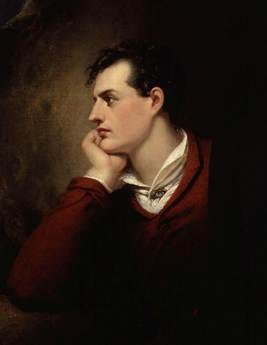
Richard Westall, Lord Byron (1813). 91.4 × 71.1 cm, oil on canvas. National Portrait Gallery, London.
The cases of Patricia Highsmith and Philip Larkin are especially vivid. Highsmith’s posthumously published diaries made clear her ugly antisemitic and misogynistic prejudices, while Larkin’s letters and biography dramatically altered his public reputation. But The Talented Mr Ripley did not in the process acquire new sentences, nor did Larkin’s poems acquire new words. What changed was our knowledge of the authors as people.
Such knowledge may make us reread the works and notice things in them we had previously missed. But if we want to argue that racism, antisemitism or misogyny inform a particular work, we still have to demonstrate that in the work itself. Biography should serve as evidence rather than act as a master-key.
We should know about artists’ lives, and criticise their conduct where warranted. We should also take the politics and morality of artworks seriously. But we should resist reducing the artwork to evidence for the prosecution or defence of the person who made it. There is a further question of whether we should also fund or honour artists who have done harm, which is very real, but separate.
The capacity to imagine people quite unlike their authors, to transform knowledge and experiences, to make beauty or terror from morally questionable material, and to create things whose meanings exceed artists’ own lives – none of these are defects in art, but among the reasons it matters so much. Art does not merely reflect the world or the artist, but adds something to that world. And if we reduce that something back to the biography of its maker, we have not understood it better, but have made it into something markedly smaller.
Ian Pace is professor of Music, Culture and Society, City St George’s, University of London. He is speaking in two Battle of Ideas sessions: From boycotts to renaissance: threats and opportunities in the arts and Benjamin Britten, 50 years on: still the nation’s composer? You can follow him on Substack, where an earlier version of this essay was first published.
An important article. Thank you. I personally have no interest in who made the art, only if the art interests me. There is far too much performative virtue.
To "the speaker opposing the motion claimed that nobody buys a book without knowing who its author is*, I can add a data point. I have quite an extensive collection of books collected over 50+ years, and spanning about ten times that number, and I know almost nothing about almost all of the authors. What I do know was found out incidentally. A good book (or music, or dance, or film) is good on its own merits. I suppose I'd better add this to the list of reasons I'm "nobody".