


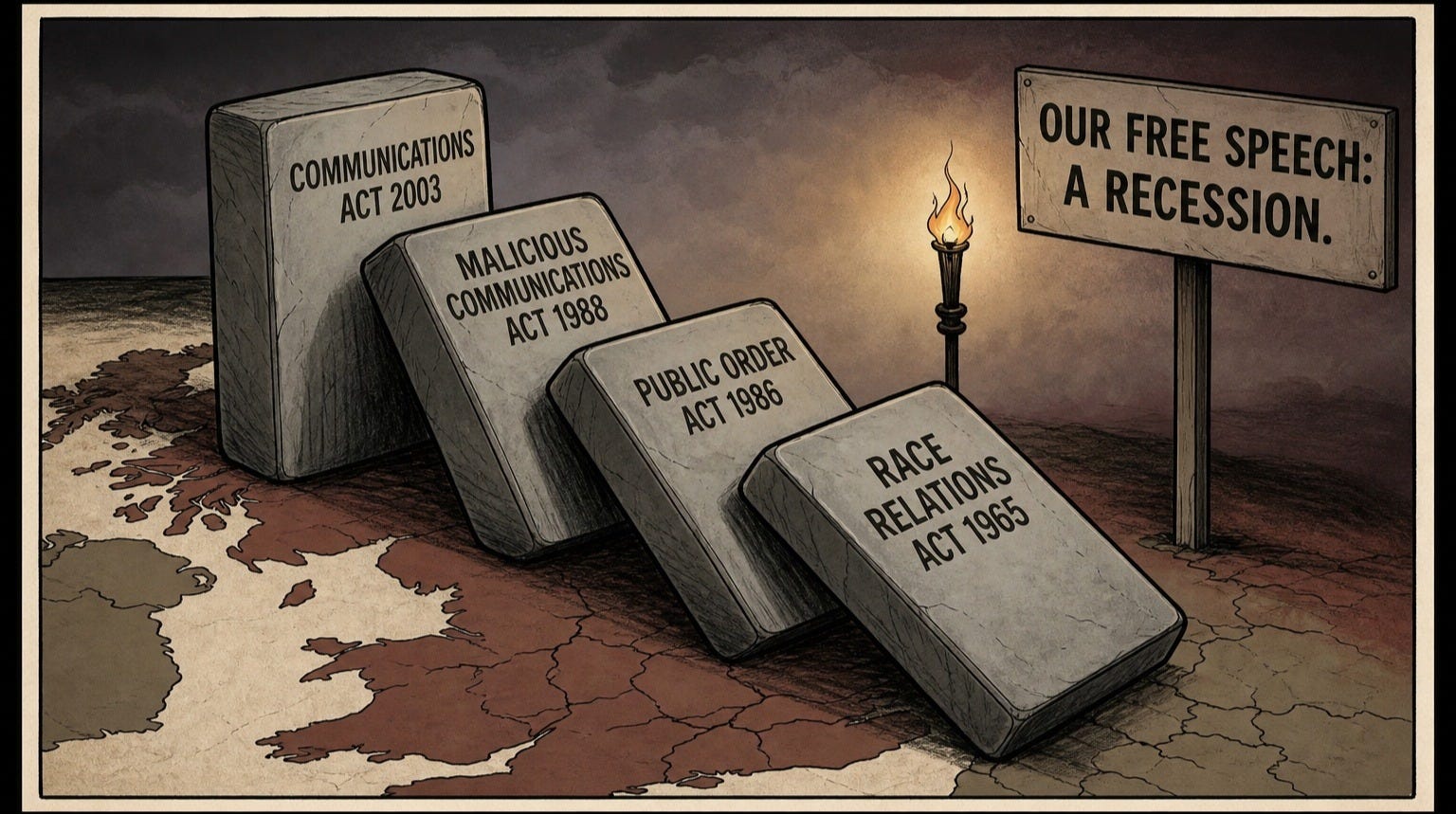
What a time to be alive. In the UK, members of the public can be intimidated into not feeling able to speak their minds – and if they do, become victims of cancellation, denunciation, social shunning and sackings. What’s more, ‘speech crimes’ mean you can be arrested, prosecuted, convicted, imprisoned – all simply for things you’ve said. It sometimes feels as though ‘Britain’s free speech recession’ is a recent phenomenon and we lash out at the latest political party in power for their censorious prejudices. Or we blame the judiciary, even though judges do not make the law, they apply it.
Which is why I was delighted to endorse a new Prosperity Institute report by Battle of Ideas regular speaker Jon Holbrook on the free-speech crisis, that usefully reminds us that there’s more to it. Jon names and shames the long tail of legislation that led us here. As he says, ‘Society reaps what statute sows’.
This is a constructive intervention as it proposes ways of stripping back legislation to ensure more freedom to speak. Holbrook’s proposed Free Speech law is the second we’ve featured here – see our Substack on the Adam Smith Institute’s Freedom of Speech Bill, inspired by America’s First Amendment. It is so good to see great legal minds addressing this issue and we will be sure to debate these issues at this year’s Battle of Ideas festival (you can buy tickets here). So, a warm welcome to guest writer Prosperity Institute’s Rhys Laverty to introduce the theme.
Claire
Britain’s free-speech immaturity
Rhys Laverty
There are many pejoratives hurled at Britain these days: broken, divided, declining. I hate to add insult to injury, but there’s another that often comes to mind for me: immature.
A strange thing to say about our nation, given that this past weekend England celebrated its 1,099th birthday. On 12 July 927AD, King Æthelstan secured control over the last Viking kingdom of Northumbria and united the Anglo-Saxon kingdoms. Our country has an institutional history stretching back more than a millennium. In that time, it developed one of the most humane, just and effective political and legal systems the world had ever seen by means of parliamentary sovereignty and the common law. Over the centuries, we matured from warring Anglo-Saxon kingdoms into a cohesive, high-trust society with immense political liberty.
A mature country is one in which its citizens can govern themselves informally with civility in the midst of disagreement and in which its political rulers deliberate thoughtfully and responsibly over the best laws as they listen to the voice of the people. Strict rules are generally meant as a schoolmaster for the young; mature adults can look after themselves. As with the individual, so too with the nation.
This once characterised Britain. But it does so no longer.
We have become an immature country and nowhere is that more evident than when it comes to free speech. Increasingly, our political rulers do not deliberate responsibly with their ears open to the people; instead, they outsource deliberation to other bodies and seek to silence the voice of the people when they think the people have said the wrong thing. Accordingly, British citizens no longer govern themselves with civility but, when disagreements arise, swiftly seek the intervention of the punitive hand of the state or the lawyer to shut down views they find offensive or alarming.
The latest paper from the Prosperity Institute, authored by Jon Holbrook, describes the need of the hour: Reversing Britain’s Free Speech Recession. Jon places the origins of Britain’s free-speech woes not in the recent rise of cancel culture, but as far back as the Race Relations Act 1965. Although that Act sought to outlaw genuine racial discrimination, it also introduced restrictions on the nebulous act of ‘stirring up racial hatred’.
By beginning with that Act, the paper illuminates a central point in the free-speech debate: Britain’s speech restrictions don’t come out of thin air but have appeared as successive governments have sought to stifle criticism in order to contain the ill-effects of other poor policy decisions.
Holbrook argues that this impulse has its origin in the Race Relations Act, which he notes was ‘the first time in the UK’s history Parliament had enacted laws that could criminalise people on account of their particular beliefs’ rather than outlawing speech on public-order grounds.
The Act was driven not just by the existence of racism in society, but also by the increasing concerns that elites had about the consequences of the explosion in postwar immigration from the Commonwealth. Commonwealth immigration had become a serious point of concern: by the 1960s, the Labour government was forced to introduce immigration restrictions. The Race Relations Act sought to deal with these concerns by using the power of the state to outlaw discrimination. The Act began a process which is recognisable today: rather than winning the argument in society, the law would be used to regulate disagreement and speech.
This dynamic continued with subsequent pieces of legislation singled out in the Prosperity Institute report, notably the Public Order Act 1986, passed in the wake of various riots, include those in Southall and Brixton, which resulted from racial tensions. The Act outlawed speech merely because it might cause ‘harassment, alarm or distress’. This is a profound break with previous legislation, which was only concerned with speech that caused a breach of the peace.
Alongside these major laws, communications offences were created in the era before the internet became ubiquitous, such as the Malicious Communications Act 1988 and Communications Act 2003. In the Blair years, numerous ‘hate speech’ laws (which are really just speech laws) made their way onto the statute book, as well. Meanwhile, in the civil realm, New Labour’s Equality Act 2010 instituted a sea change in anti-discrimination law, which turbocharged the ability of aggrieved minorities to assert themselves unjustly at the expense of the majority of British citizens.
In the 2010s, this suite of laws collided with two major shifts, one material and one cultural. First, the rise of social media, driven by smartphones post-2012, gave everyone a public voice via their posts online. Second, the cultural dominance of ‘wokeness’ from around 2016 has entrenched a particularly aggressive kind of political progressivism as our default cultural milieu.
There is something of a chicken-and-egg relationship between these laws, technological innovation, and our current free-speech crisis in the era of cancel culture. But our laws have certainly shaped culture to a significant extent. We have now regressed from being a mature, high-trust nation with a robust civic realm and social fabric to an immature, increasingly zero-sum network of interest groups who either exert immense social pressure on one another amidst disagreement or call in the increasingly well-armed apparatus of the state to police speech. We have become like petulant children constantly running to parents to sort out our conflicts.
The Prosperity Institute’s new paper provides a way back to free-speech maturity for Britain.
First, it recommends the repeal of Section 5 of the Public Order Act 1986 and its outlawing of speech that merely causes ‘harassment, alarm or distress’.
Second, it recommends repealing a raft of outdated and onerous communications offences, replacing them with a single offence for communications speech that is intentionally menacing and targeted.
Third, it recommends abolishing all so-called ‘hate speech laws’.
Fourth, it recommends removing religion and belief protections from the Equality Act and replacing them with a simple tort of unlawful interference with free speech.
Finally, it recommends a costs regime for legal cases to deter spurious allegations and to protect those unjustly accused.
Britain is not Peter Pan: we did grow up – into one of the most gloriously mature nations the world has ever seen. But we have become like Benjamin Button, aging into infancy with every passing day as we lose the capacity to govern and disagree amongst ourselves.
Our politicians cannot continue to use speech laws to avoid scrutiny of their failed policies. If we want to grow out of our free-speech immaturity in the long term, they must listen when voters tell them unsavoury truths about the failures of things such as immigration policy. But we must begin by restoring the right of Britons to voice their criticisms without fear of censure.
Rhys Laverty is editorial and research director at the Prosperity Institute. You can read Jon Holbrook’s report, Reversing Britain’s Free Speech Recession, via the Prosperity Institute website.
More
Cancel culture nearly ended my legal career, but I fought back
Jon Holbrook, Daily Telegraph, 13 July 2026
Watch Rhys Laverty and Jon Holbrook outline the main points of the report
Thanks, Rhys for a great analysis of the situation.
We so need to repeal all 'hate speech' laws!
Have cross posted
https://dustymasterson.substack.com/p/helen-of-troy-the-face-that-launched
Dusty