

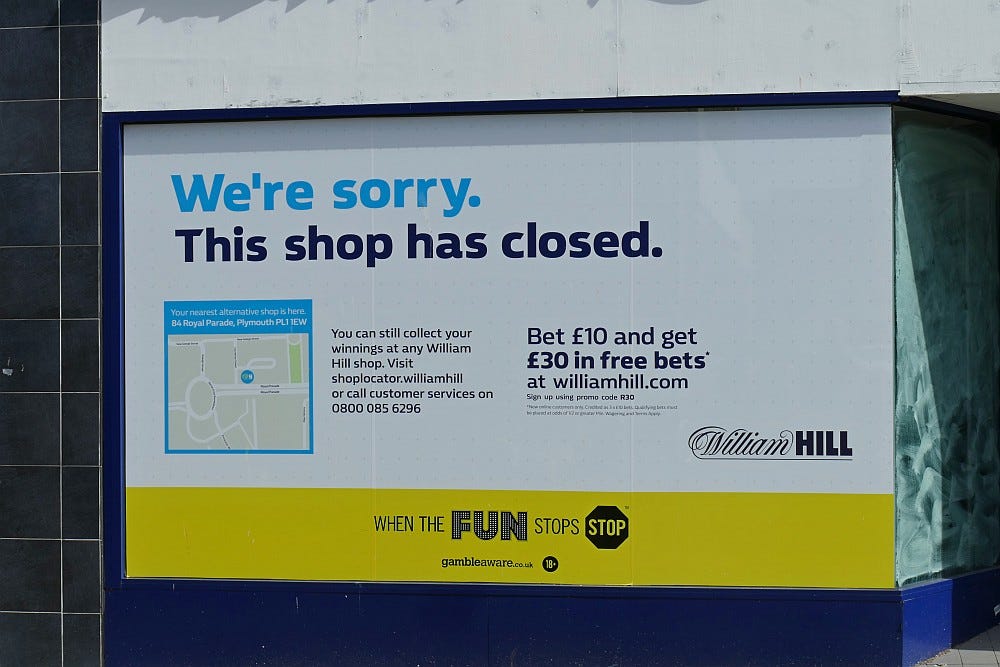
The high-street bookie is the latest victim to be sacrificed on the progressive altar of refusing to admit the thing. In this case, that thing is the growth of an illicit economy operating in plain sight on once lively and welcoming high streets. And the thing is also a black market often linked to illegal migration, as evidenced in a series of investigative films produced by both the BBC and Channel 4.
Our new prime minister, Andy Burnham, has shamefully grouped legal and illegal – or at least potentially illicit – businesses together in announcing his plans to ‘save’ Britain’s high streets. His proposed reforms would give councils significantly greater powers to prevent new betting shops and adult gaming centres from opening, while vape shops would face tighter planning controls. (To note, while a plethora of vape shops may be dodgy, many are perfectly legally supplying a popular product, to erstwhile smokers who have taken up vaping to help them off the fags.) The government also intends to scrap the Gambling Act’s existing ‘aim to permit’ approach to licensing.
Of course, the public are not concerned about the rise of barbershops because men suddenly want their hair cut more frequently. The public are concerned because there is credible evidence that criminals are using cash-heavy, low-capital-cost and lightly regulated businesses to launder money. This at least partially explains why both barbers and vape shops have grown in recent years: barbers from 2,953 in 2015 to 18,078 in 2025 and vape shops from 262 to 3,776 – although that is the period in which vaping has taken off, of course. All the while, betting shops have been shutting their doors - falling from 8,822 to 5,872.
Bookmakers are not an unregulated grey economy. They are licensed businesses operating under gambling legislation, subject to Gambling Commission oversight, age-verification requirements, anti-money-laundering obligations and an increasingly onerous tax and regulatory regime.
Lumping a legal, highly regulated industry in with two lightly regulated industries – that are subject to concerns about dubious visas and money laundering – allows Burnham to claim his reforms are about limiting ‘anti-social’ behaviour, rather than tackling rising criminality. It allows him to avoid the difficult question: why have Britain’s high streets both been hollowed out and fallen prey to the black market?
These reforms certainly won’t save our high streets which, somewhat ironically, are dying from much the same disease as the bookmaker. Even without Burnham’s latest intervention, William Hill alone cut its estate by around 300 shops in just 12 months, citing high taxes, excessive regulation and changing consumer habits pushing spending away from the high street and online. That is a diagnosis I’m sure many business owners on the high street would recognise. The empty Betfreds, Ladbrokes and William Hills won’t be replaced by quaint little cafés or small-plates restaurants, but by squatters taking advantage of empty shopfronts.
More ironic still, bookmakers were already so heavily taxed and regulated that consumers were increasingly being pushed away from the legal, regulated market and towards the black market. Burnham’s answer? More regulation. How very 2026: announce reforms to solve a problem you refuse to admit exists, while simultaneously making that problem worse.
In fact, before this policy announcement, H2 Gambling Capital forecast that the illegal gambling market will capture 22 per cent of all betting by 2031. As the net tightens around what gambling firms are allowed to do, Belgium serves as a stark warning to policymakers – with half of young men using the black market to gamble online after a decade of over-regulation.
What the gambling industry must realise is that there is no compromising your way to survival under progressive governments. Asking the gambling industry to lower the risk of harm is reasonable, and the industry has responded by welcoming GAMSTOP, deposit limits, affordability checks, increased age verification, etc. But for progressives like Dawn Butler, no level of risk is acceptable – and risk can never be eliminated entirely if you want to have a gambling industry. At the end of the day, campaigners will always argue that some risk remains – and have more or less openly admitted that the end goal is to destroy the gambling industry in the UK. Butler, who is behind this campaign, responding with ‘lol’ on X to another anti-gambling campaigner mocking the industry.
Another Labour MP, Marie Rimmer, posted on X: ‘[W]e’re all fed up with our high streets being taken over by businesses that don’t contribute to our community’. Alas, what does the butcher do for the vegetarian, the pub for the teetotaller, the florist for the loveless and the bookie for the risk-averse square? That’s obviously not how high streets work. Their value comes from precisely the opposite principle: a collection of different businesses serving different people with different tastes, habits and vices. A shop does not cease to ‘contribute’ merely because a lanyard MP – or indeed half the town – has no desire to enter it.
When he was mayor of Manchester, Burnham said: ‘Let’s be clear who is most affected by a Tier 3 lockdown: it is the people working in pubs, in bookies, driving taxis. People too often forgotten by those in power.’
Well, if only you’d kept forgetting about them, Andy, they’d be much better off.

