

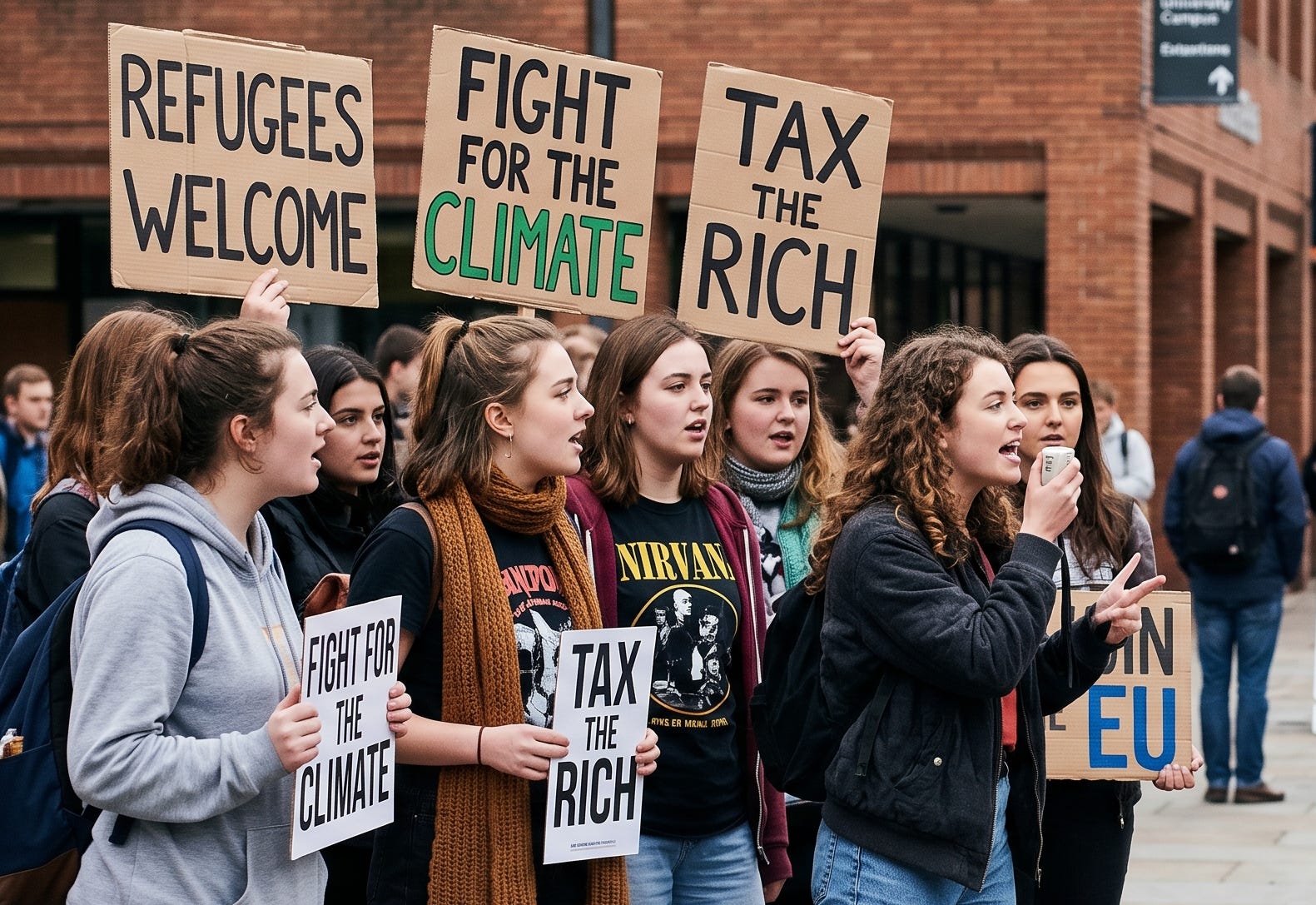
With the local elections approaching and predictions of a mass exodus away from the traditional parties, there has been concern raised about the generational and gender divide in voting intentions. Many mainstream politicians remain preoccupied with nightmares about ‘far-right’ male youth, seeing the ‘manosphere’ as a fundamental factor in Reform’s expected successes. However, with the rising popularity of the Green Party among younger voters, is it time to look at the other side of the coin: is the rise of extremes being led by young women?
Contrary to popular opinion, young men are not so much moving to the right as young women are moving to the left. While this has been picked up by recent polling, the extent to which youth polarisation is being driven by the rise of the right, rather than the dominance of the Green Party, remains often overstated.
Polling and research conducted by Onward in October last year showed the growing polarisation between men and women, not just in the UK but across the world. Young women were more likely to vote Green (by +9 per cent), while young men were more likely to vote for Reform (by +15 per cent). But this has been contested by more recent statistics. Current YouGov polling shows that at least 36 per cent of 18- to 24-year-olds are intending to vote Green, compared to only six per cent for Reform. Seemingly, there has been a much larger shift to the left than to the right.
The extent to which young women are moving leftwards is often underestimated. As Scarlett Maguire reports: ‘We often hear about a lost generation of young men’, yet young women are more pessimistic (and then, perhaps, more radical). They are much more likely to say the UK is a racist country (43 per cent vs 29 per cent), and similarly more likely to believe that the UK still holds sexist beliefs (39 per cent vs 30 per cent). They are less likely to feel connected to their country or feel that they benefit from capitalism. This is strange for a generation of young women who have never had better economic opportunities; they now hold 56 per cent of university places, and on average earn nine per cent more in their twenties than their male contemporaries.
So why is it that young women have become so disillusioned and pessimistic? As Maeve Halligan argued at Battle of Ideas North in March, women are particularly vulnerable to the progressive politics of empathy. They have been taught to care, and care deeply. They have internalised the teachings of anti-colonialism, social injustice, and mental health. They have sided with the perceived ‘underdogs’ rather than those they believe are benefiting from the status quo.
But is this not riddled with hypocrisies, or at least some level of cognitive dissonance? Why would progressive young women, often super-sensitive to any or all evidence of racism, turn a blind-eye to the Green Party’s evident soft-soaping – or even endorsement – of hatred against Jewish people (perhaps the oldest form of racism)? Why would hyper-feminist young women embrace a party that is viciously intolerant of gender-critical views, and forgo women’s single-sex rights without a pause?
Perhaps, as Halligan implies, it’s because, in vibes terms, the Green Party is on the right side. Its policies – campaigning on ‘fiery mix of anti-billionaire, anti-landlord, pro-Gaza rhetoric’ – are popular with disillusioned, middle-class young women. These women have been socialised by virtue signalling and performativity, and this is how they will vote. They reflect the sentiment of the Green Party and proactively concern themselves with every group other than the ‘straight, white, able-bodied men’ because they see the world through a framework of victimhood, leading them to believe that the structures of power (and therefore oppression) must be deconstructed, even if these structures benefit them.
Gen Z have been radicalised by the lens of ‘affective polarisation’, having been encouraged to see politics in moral terms: not in terms of differing opinions or ideologies, but rather in terms of good and bad. That makes it much harder to connect or understand across political divides. And as young people are more ‘alienated’, ‘pessimistic’ and ‘isolated’ they have become more paralysed by the fear of being ousted from their social group. Therefore, while they are increasingly exposed to more radical ideas, they are simultaneously unable to speak freely about their genuine beliefs and concerns.
All this means that even if young women don’t agree with everything on the Green Party’s agenda, they are much less likely to vocally disagree. There is a perception of radical progressivism that has been popularised by social desirability and conformity.
Arguably, the loneliness epidemic among young people has radicalised them. As they have become more dependent on the politics of their group, which is often policed online, they have limited themselves massively in who they connect with. The recent polling highlighted a concerning chasm between men and women, not in the ‘big P’ political polarisation, but in their ability to form personal relationships. Only 35 per cent of women under the age of 25 admitted to having a positive view of men, and the distaste and distrust of men is leading them to opt out of dating at all.
The so-called ‘femosphere’, or at least the normalisation of fairly radical feminism online, has for a long time aimed to take down toxic masculinity. The concerns bought to light by the #MeToo movement have been further amplified in recent years by the moral panic around porn and incels. This, coupled with the fearmongering around men moving to the far-right, has given rise to the idea that it is now ‘embarrassing to have a boyfriend’ and women have become more neurotic about which men, with what ideas, they engage with. Ironically, this is scaring away most of the decent men, who are terrified of asking a girl out in case they get accused of acting inappropriately. For a generation who are already more risk-averse and introspective, the idea that men pose an inherent risk to women’s safety is not something that we should be entertaining or pushing any further – unless we are pushing for a completely divided and atomistic generation.
This has often been justified as a response to the rise of right-wing men. But perhaps this is a reaction to a moral panic of the elite, who are exacerbating the mood amongst the most extreme and disaffected in the manosphere to amplify the fears of radical right-wing boys, when in reality only a minority of young people are voting for right-wing political parties. But what they fail to realise is that by pushing young men away, they are only going to radicalise them further, leaving both sexes ‘lonelier and angrier’, with less understanding of the other, than before.
But whether you agree with the Green Party’s policies, think it is a good thing that young people are becoming radicalised (as at least they are engaging in politics), or find both these things horribly concerning, the main issue for many young people is a crisis of fragmentation and loss of common ground. This is why Ideas Matter is running its annual Living Freedom Summer School – three days of lectures and discussions in London for 18- to 30-year-olds in London on 9-11 July. This is a chance for young people to debate the ideas and ideals of freedom from all different perspectives and angles. Click on the button below to find out more and to apply.
